Monday, 19 August 2019

The Luminous Dead, by Caitlin Starling

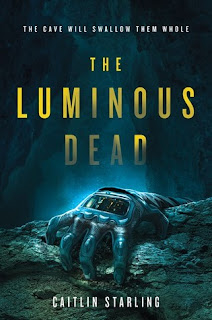
book cover The Luminous Dead has only two active characters: a cave diver, covered in a special suit that enhances her strength and completely isolates her from the environment, and her handler, the person who guides and provides support remotely. At first glance it's a sci-fi story, as it happens on another planet, with futuristic technology, different rules, alien lifeforms, etc. However, it starts to itch at you that with the tech that was described, the tasks at hand could have been completed a lot more efficiently and safely, so what gives?

Turns out the story is more of a metaphor than a fantastic cave adventure on another planet. Probably inspired by the death of Caitlin Starling's mother, it explores the damage done by losing your parents, the obsessions that drive the affected, the extent to which someone will go to quiet those voices in their heads. But I liked it. It's got just enough action and adrenaline to keep you going while it touches the painful emotional bits that the book was really about.

Bottom line: I urge you to ignore all technical aspects of the story. It's not that the author did not made the effort to make them believable, it's that they are irrelevant to the moral of the book. Also ignore the wild emotional fluctuations of the characters: they are supposed to behave that way. The book feels as if following a personal journal with the events of the story being just sci-fi versions of the items there.

Sunday, 18 August 2019

The giant house spider

While being hosted in a small house in the Arges county, I found myself face to... err... hairy body to hairy body with a large spider, at least 10 cm from the tips of the front legs to the tips of the hind legs. The body itself was about 2 cm in length. I tried to catch it, but it ran away and I didn't exactly feel safe handling it. However, from my standpoint, the adventure was just beginning. It starts with a picture:


In a previous post, I was telling you about a web site that recognized plants from blurry pictures I had taken. I assumed that somewhere there was something similar for spiders. Alas, it doesn't seem to be the case, so I reverted to the classic Google search with descriptive words: a European spider 10 cm in length. I found it almost immediately, clearly a member of the genus Tegenaria in the family Agelenidae. Or is it?

Funny enough, most of the spiders assigned to Tegenaria were recently (2013) moved to another genus, Eratigena, based on DNA and molecular analysis. So my spider, likely a "giant house spider", can be found either as Tegenaria atrica or Eratigena atrica (not to mention Tegenaria duellica, Tegenaria gigantea and Tegenaria saeva). I also can't be completely sure of the identification. As far as I can tell, it's a male, based on the large (pedi)palps, used not only to hold on to prey, but also to deposit sperm in the females. But while I think it looks most like an atrica, based on the pictures I found online, it could also be an Agelena labyrinthica or a Tegenaria parietina, even if the first is found in Denmark and should be smaller and the second is rare and native to Central Asia.

Considering it's a giant spider I found in a house, I will go with Eratigena atrica, but one has to wonder how active biology as a science is to have species of common arthropods reassigned from one genus to another just a few years ago. So yeah, a nice little story, for me at least, all starting from a picture of a spider in a bathroom.

Wednesday, 14 August 2019

Tate no Yuusha no Nariagari, or Rise of the Shield Hero. A ridiculous, but fun anime.

Tate no Yuusha no Nariagari is one of those isekai animes where a normal Japanese boy is summoned in a magical realm to fight monsters. Once there, he realizes that the world and his character work exactly as in a fantasy video game, complete with items with upgradeable stats, waves of monsters and revealing female armor. He is summoned there with three other heroes, also from Japan, only from alternate universes, each of the heroes having their own magical item that defines their style. His item is a shield and immediately he notices that he is treated differently, with all honors given to the other three and only disgust for him. Long story short, he is forced to hone his skills through his will and efforts alone, while the others, spoiled by their environment, make no effort and therefore level up less.

I liked this anime and I will continue to watch it, although it's a bit ridiculous. I've read the manga as well, which is also new, and there are slight differences in the sense that the anime is a little more serious. If you want a mindless game like experience in anime form, go for it. Here is a trailer:

Violet Evergarden, a really nice anime, with an uncertain future

Violet Evergarden is set in a steampunk universe in which technology, other than metal prosthetics, is at the 19th century level, and the main character is a girl that was used as an elite child soldier in a terrible war who now has to find a purpose in a civilian life. She takes on the job of a "auto memory doll", a person who needs to put into words the feelings of others. That's a bit of a stretch, because she doesn't know how to feel herself... it's like me taking on a job in psychology or artistic design so as to learn a new skill. Certainly great for me, but kind of sucks for my employer!

Anyway, the animation is really well done and the acting is top notch. The story itself is beautiful, even if at times inconsistent. After watching the 14 episodes of the first season, I was itching for more, only to hear from a colleague that the studio responsible for the animation, Kyoto Animation, was destroyed in a terrible arson attack. That doesn't bode well for a sequel, yet a spin-off film had already been announced, so who knows?

Bottom line: it's not for everyone. PTSD romance, I would call it. But it nicely animated and I liked the story. I felt that the characters were a bit off, but not annoyingly so. Here is a trailer, in English:

Tuesday, 13 August 2019

The Binding, by Bridget Collins

book cover There is a trope in fantasy writing that goes like this: young person is uprooted from their life as they learn a new skill or gain a new power, while people in authority teach them things so slowly and inefficiently that the young person needs to make efforts to learn by themselves. Harry Potter had it. The Binding has it. Only in the case of this book, the young person is someone who is always sick without knowing why, is suddenly sent off from home to be an apprentice for someone he doesn't know and while he understands nothing of what he is supposed to do. Months later and 25% of the book in, he still hasn't learnt anything, although he is always tired and exhausted for no good reason whenever he is about to. If he doesn't collapse, his mentor will! And, spoilers ahead, his mentor then dies.
So after a quarter of the book, absolutely nothing happened while I had to suffer a depressed weak and barely teenage boy who didn't want, know, or want to know anything. Bridget Collins' writing is competent and I am sure things are going to get better from here (I mean, they can hardly get worse), but I just won't continue to read the book.

Friday, 9 August 2019

Magic for Liars, by Sarah Gailey

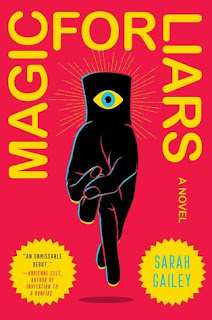
book cover Magic for Liars is one of those stories where magic exists in a hidden layer of our world, yet it doesn't bring any happiness. People are still people, regardless of their power. And what better way to explore human nature than writing a detective story in a high school for magical kids?

Sarah Gailey writes the story from the viewpoint of the detective, a woman who's greatest frustrations stem from her sister being a magician, while she is just "normal". Yet when she is tasked to find out the circumstances of the death of one of the teachers in the magic school, she jumps on it, making her realize more about herself and the relationships with family and other people.

Yes, the magic is quite incidental and the detective part quite secondary and it could just as well been written in a space academy or science lab or anywhere where flawed people have to manage each other and the balance of power between them. And while I feel the main character was compelling and the story well written, I can't quite shake the feeling I've been duped into reading a touchy-feely type of drama that I didn't really intend to read. You will not read about the specifics of magic in any kind of way; it is quite bluntly used as a tool that the reader needs not understand. You will not be amazed by the amazing feats of deduction of a fascinating detective; the main character is by definition a very normal person with a penchant for introspection and focusing on her own messed up feelings.

In the end you know the spouse did it, or the butler, or the person who flirts with the detective, or the god-like magician, or the weird kid. The culprit isn't even that important for the plot. It's all about the theoretical dynamics between the people and what makes them tick.

Bottom line: a fine investigation into the core motivations of people, woven in a rather short and bland story which purely incidentally features detectives and magic.

Thursday, 8 August 2019

When is efficiency bad? TED talk: The human skills we need in an unpredictable world, from Margaret Heffernan

The talk is a bit overreaching, doing more things than it should have tried to do, in other words not very efficient, but it contains some really interesting ideas and it's extremely well articulated. As a software developer, I always thrive for efficiency, but what Margaret Heffernan says is that efficiency is good only when the future is predictable. In a fast changing world (and getting faster), efficiency doesn't just not help, it makes things worse. Sometimes you can't plan, but you can prepare.

As expected, I wasn't as interested in the humanistic part of the talk as I was in the technical aspects: algorithmic efficiency is only good with things that can be measured. If you want to innovate or to adapt, it's trial and error that works best. I got that giddiness I get when people tell me "you can't do THAT in software!". Oh, ye of little faith! But there is something there, something extremely useful, a tool that I can use whenever I get stuck in logic loops or some manager tells me that he needs data in order to make a decision about the project that would generate the data.


Margaret Heffernan: The human skills we need in an unpredictable world