Monday, 28 December 2009

Deadhouse Gates by Steven Erikson

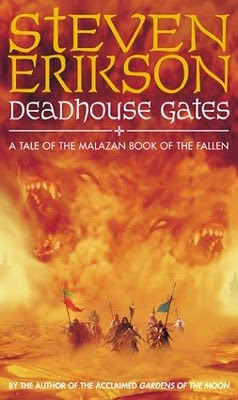
book coverThe second book in Steven Erikson's Malazan Book of the Fallen series, Deadhouse Gates starts from where Gardens of the Moon left, using some of the characters, but in a completely different storyline. Thus, it can be read as a separate book.

I found Deadhouse Gates to be both better in the good parts as well as worse in the bad parts than Gardens of the Moon. The characters are more complex, the storyline more interesting, the battles more epic, but the magic is even stronger, its power never truly explained or detailed so that it fits in the background. What use is an army, if a single mage can obliterate whole realms? How does a human empire span so much land unchallenged, while creatures that can crush it singlehandedly exist in the world?

As expected, the characters more their separate ways, occasionally meeting for brief periods of time, but essentially having their own story arches. There is the Coltaine arch, with the moving story of a brilliant commander protecting thousands of ungrateful whiny rich refugees; the Felisin arch, which describes the life of the younger Paran sister, driven by the hate towards her older sibling and adjunct to empress Laseen; the story of Kalam, the assassin, in his quest to kill Laseen; the tale of Crokus and Apsalar and Fiddler, travelling the magical desert Raraku; finally, the story of Icarium the Jaghut and Mappo Runt, the Trell, both insanely old and searching for Icarium's lost memories.

Great book, I started reading the third in the series and I don't see me stop until I finish the entire Malazan saga. I found an interesting link that can serve as an encyclopedia of the Malazan universe. Here it is: Malazan universe.

Wednesday, 23 December 2009

Joy of Thinking, lectured by Ed Burger and Michael Starbird

Joy of Thinking: The Beauty and Power of Classical Mathematical Ideas is an earlier math course, staring a long haired Ed Burger and his Texas U colleague Michael Starbird.

Many of the ideas in Introduction to Number Theory have obviously originated here, however I didn't find this course so interesting, maybe because it was not so well thought trough or maybe because it was clearly targeted at a lower level of understanding and the many repetitions of basic ideas kind of turned me off.

The content of the course is structured into three parts: Numbers, Geometry and Probability. The first part contains very little that has not been covered in Introduction to Number Theory. The geometry section is a bit interesting as Michael Starbird takes us through some topology, talking about the Möbius strip and the Klein bottle. The last part is basic probabilities, although there are some interesting problems studied there.

Overall, a fun course, better suited for people that are really not into maths, but more into interesting ways of thinking. The last lecture summarises the life and thought "lessons" learned from this trip into mathematics.

Monday, 21 December 2009

EasyReplace - replace files in a folder hierarchy with newer versions

Yay! New Github project: EasyReplace.

What it does is replace all files in a folder hierarchy with the files you drag&drop on the app info box. It is very helpful when you want to replace old library files or some other versions of your files with newer ones without having to manually navigate through solution folders.

Life on Mars revisited

...and no, I am not talking about the Ashes to Ashes spinoff of the British series, I am talking about actual life on Mars.
Microscopic picture of the meteorite
Remember in 1996 when everybody was talking about finding signs of life in a meteorite that came from Mars? At the time the theory was dismissed because other causes for the structures in the meteorite were thought to be valid. Here comes a new study from december 2009 that invalidates the proposed non-organic processes in which the features on the martian rock could have been formed.

Yay! Merry Christmas, green guys!

Saturday, 19 December 2009

Large Hadron Collider TV

Here is a small funny video combining music and science in a geeky mix. I know, the music could have been less 80's rap and the dancing... well, could have been dancing. I mean, if even I noticed a lack thereof, it must really have been awful. But then it wouldn't have been geeky enough, right ;)

Thursday, 17 December 2009

Introduction to Number Theory, lectured by Ed Burger

What a fun course this was. The lecturer of Introduction to Number Theory, Ed Burger, a math PhD, looks like what one would expect a mathematician to look like: thin, tall, geeky looking, wearing a rather bland costume, but with a colorful tie, curly hair and large glasses, with a sincere smile that seems a bit sad. The thing is, he is also a lot of fun and his enthusiasm regarding mathematics is not only obvious, but catchy as well.

The course itself requires very little if any mathematical education to understand, being mostly about ideas, rather than formulas. It is a Teaching Company course, and each lecture builds upon the understanding from the previous ones, making surprising and really fun connections.

I was very sad when the course ended, I wanted more! Happily, I've got "The Joy of Thinking" and "Zero to Infinity - a History of Numbers" that are also lectured by Ed Burger and I can't wait to watch them all. I highly recommend the course, even if one is not interested in math. It opens the mind on a way of thinking, useful in any situation, rather than anything specific.