Friday, 8 February 2019

In Pieces, by Sally Field

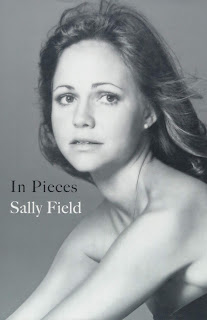
book cover In Pieces is a nice read. It made me understand things about people and women in particular that I had no chance of knowing because, let's face it, all people lie about themselves and films lie about everything. Sally Field is both very honest (I mean the effort is palpable) and narrating her own version of the story of her life. Can you trust it? Can she trust it? Before you ask how did she remember what she did as a young woman when she wrote the book at 71, learn that she obsessively kept daily journals about her life. She kept reviews to her films, random pictures of her on the filming set or with her family, letters and so on. Funny enough, she never read the reviews until much later. I think that was wise. If this post were printed, she probably would keep it, too.

The book starts with Field's childhood, described as a continuation of the lives of her mother and grandmother, goes through her personal and work life until she is about 40, when she wins the Cannes Palme d'Or and the Oscar Academy award (her first) in the same year. I feel like she thought that was the peak of her life and the next twenty plus years (and a new marriage and a new son) are described in mere paragraphs. However the ending is very emotional as she tells the story of coming to terms with her emotional issues, going to a psychologist for the first time and finally talking frankly with her mom - at the age of 63! It's never too late - and ending with her mother's death.

I loved the way she explained how the different pieces of her soul worked, hence the name of the book. I usually say what I mean and even if I am plagued by many personalities of my own, when I am duplicitous I usually planned and made a huge effort to do it. It must be the same for most other men, I think, because in our discussions we often decry the seamless way in which women can become someone else entirely, hide and basically cheat when interacting with others. A 2015 study on 2000 people showed that women lie about two times more than men, but an overwhelming majority of lies were told in order to make someone feel better, to avoid trouble, or to make life simpler. However, in Field's bio I have finally understood that sometimes this is not voluntary, it is a defense mechanism, it is something you learn from childhood when you have to be the nice little girl and fit in and still face cruel reality. A person can be open and social while at the same time being shy and introverted. It's not somebody being duplicitous, it's someone exposing the part of themselves that they feel will fit in. Of course, that's her take on it, but I dug it.

Bottom line, I think it was a lovely and informative book, even if it described child sexual abuse, matter of factly sexual harassment in the film studios, dysfunctional relationships with men that needed sexy stooge caregivers, not partners, and psychological dissociation in order to survive through it all (and act brilliantly). This is the second actor autobiography I read, after Peter Coyote's (which I highly recommend), and I loved both of them. Perhaps this is a genre that appeals to me because actors are taught to connect to their emotions and to become different people while staying aware of their true core, and so their autobiographies are more detailed, more personal. I will read more of these.

Monday, 28 January 2019

The Ballad of Black Tom, by Victor LaValle

book cover The Ballad of Black Tom is yet another book inspired by Lovecraft and featuring racially abused people of color. But unlike Lovecraft Country, this is not funny or adventurous, it is just painful. LaValle creates a complex character, a black man who respects his musically talented father, but neither did he inherit his old man's gift, nor can he abide by the man's strict moral code. In a world where magic exists at the fringes of human perception, he dabbles with things he should not and suffers for it. Stricken by grief, he becomes Black Tom.

I thought the story started kind of slow, then went a bit too fast, then ended too abruptly. Victor LaValle made me fall in love with the character, only to finish the standalone book on a vague note. After reading several stories that I was hoping were not sagas or trilogies or whatever (and they were) I finally get to one that I wanted to continue and it doesn't.

Bottom line: good book, but the main character was better. He deserves more than this.

Sunday, 27 January 2019

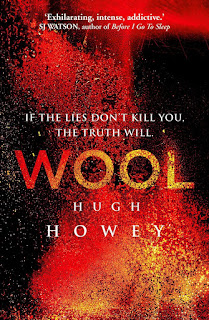
Wool Omnibus (Silo #1), by Hugh Howey

book cover Wool Omnibus is the first novel in the Silo series, by Hugh Howey, and comprised of several short sequential stories that are connected to each other. It's a post apocalyptic book, where people are cooped up in a "silo" to survive a world that has become so toxic that only minutes outsides dissolves an air tight suit and then kills you. But what is really true?

For almost all shorts, the lead character is a female mechanic who is both a great problem solver with high technical skills and a woman, so the perfect character for the age. I found that she was a compelling character and so I could read the book in a day. There isn't much else to say outside what I already described. It's easy to read, easy to empathize, easy to forget right after. In truth, the most interesting of the short stories was the first, because of its twist. The rest is a classic hero's journey, complete with egomaniacal villains and Romeo and Juliet like romances.

Personally I enjoyed the book, but I don't feel so engaged as to continue reading the series. It's typical Young Adult, even if the young adult is 34 and a competent mechanic. The tale came close to a sympathetic villain, which is one of the main things in great storytelling, but in the end it settled with the classic rule abiding tyrant that has to be overthrown by empathetic heroes. Average pulp, I guess.

Bird Box, by Josh Malerman

book cover I didn't like Bird Box. Josh Malerman seems to be a good writer, but the way he chose a cliché as the main character just in order to skirt the explanation of what happened and avoid any actual attempts of problem solving annoyed the hell out of me.

Imagine a world that is suddenly invaded by something, nobody knows what, but just one glimpse of it would make anyone (including animals) intensely suicidal. The main character is a young woman, left pregnant by some guy she randomly met, who has to deal with this new situation. Whenever the character gets too close to actually thinking about a solution or talking to someone who could find one, she gets all emotional because... children. This is such an ugly and demeaning trope.

The action is not that intense either. Imagine some people worrying day and night because they can't open their eyes. Yes, you can't drive! The horror! In several years covered by the out of sequence chapters no one actually attempts to function as a blind person would. The author just dismisses the possibility that true life without eyes makes sense. Everyone is stumbling (blindly) and relying on their hearing by shouting "is anyone there? go away!". Unless this is a metaphor for US foreign policy stupidity, these ideas fell on deaf ears with me. Deaf, get it?

Anyway, there is a Netflix movie made after this book, I have no idea why. It is could be better than the book, but that isn't a high standard.

The Psychopath Test: A Journey Through the Madness Industry, by Jon Ronson

book cover I thought The Psychopath Test was not extraordinarily well written, but I enjoyed it. Imagine Jon Ronson, a tiny overanxious journalist and writer, going around the world to discover who are these psychos, what are they and who made or declared them thus. At times he has to make a connection with people who have violently killed or tortured others and I feel like only Woody Allen would make these scenes justice. A movie adaptation has been announced in 2015, with Scarlett Johanson in the main role and written directed by someone I don't know. What role would that be, though? There are no lead female characters in the book, although there is a woman who was caught in a bomb blast and then had to defend she even existed to a bunch of asses.

Anyway, what threw me off a little was the article/blog style of writing (called gonzo). It's not bad, I just wasn't expecting it. It feels like Ronson wrote several articles, with some overlaps, then glued them together to paint a larger picture. The result is an image of various widths and with some holes in it rather than a smooth picture. It does feel more personal, though, and perhaps this is what it should have been all about: the journey of a writer, hence journalism.

The book is not large and it is easy to read. In it we learn how psychopaths behave, why they are different from the rest of us, who created the rules used to spot them and, coming full circle, wonder if any of it is real. I think it was informative, but there are probably a lot more things to be said on the subject. As a personal journey to discover the meaning of psychopathy, it's a good book.

Monday, 21 January 2019

Lovecraft Country, by Matt Ruff

book cover Lovecraft Country is a collection of short stories that are all linked, with the last bringing them together. It's a very fresh and original take, shining a light on racism in America in the 1960s, but also bringing in bits of the Lovecraftian fantastic. And to Matt Ruff's credit, he does both very well, considering the abysmal record of people trying to adapt Lovecraft and also that he is a white New-Yorker.

The heroes of the book are a family of Negroes (their word for it) and while magic and curses and monsters and parallel dimensions are present, the only horrific elements of the story is how they are treated by the white population. Yet they stay positive and resilient and survive. Each short story focuses on one of the family members, sometimes two, but only in the end they all play a part. I found the character of Caleb Braithwaite compelling, too, a roguish and charming magician, very similar to Jack Nicholson's devil character from The Witches of Eastwick.

I recommend the book and I feel like I want Ruff to write more in this universe.

Sunday, 13 January 2019

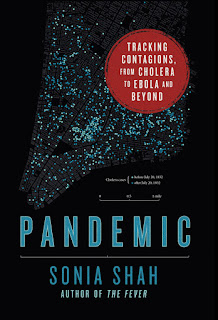
Pandemic: Tracking Contagions, from Cholera to Ebola and Beyond, by Sonia Shah

book cover After I've read Barry's The Great Influenza I had resigned myself to never read a book as well researched, as interesting and as viscerally informative, so when I started reading Pandemic, by Sonia Shah I had low expectations. And the book blew me away!

While I did notice some factual errors along the way, stuff that was either insufficiently researched or used for dramatic purposes, Pandemic was amazingly good. And terribly disgusting. If Barry took the high road of celebrating the heroes in the fight against pathogens, Shah writes so that every chapter destroyed more and more of my fate in humanity. By the end of the book I was rooting for a disease that just comes and kills us all to spare us the embarrassment of being human.

I mean, the investigation starts with cholera and the undignified way in which it makes you involuntarily squirt every liquid you have until you look and feel like a desiccated corpse and if you don't die the chances are people will confuse you with a corpse and bury you alive. But then it got to the horrid conditions that existed before the 20th century even in New York, a place where the population density exceeded that of modern Tokyo five times and people would wallow in their own excrement thrown in the streets and infesting their water supply. Then it described an epidemic of cholera in such a hellish place; can't get any more disgusting, right?

But wait, then there is a chapter on corruption and how financial interests caused the death of thousands just so some people can build a bank corporation like JPMorgan Chase, the biggest US bank today, built on literally feeding shit to people until they died. Diseases not allowed to come into the public eye for the sake of tourism and all that crap. Can it get worse? Yes, because once the disease is there, the blame game is on. The cause of the disease is not germs, the blame is not on a corrupt medical or political system, the fault lies solely on dirty immigrants, gays, minorities and if all else fails, the aid workers that are trying to help, but probably brought the contagion themselves on some sinister agenda.

And then we get to the point where we learn our brilliant present is based just on the ignorance or indifference to present dangers or current super bug pandemics. After all the horror the book presents, the end result is but a whimper, business as usual, ineffective uninformed lethargic reactions to attacks that started decades ago and were completely ignored (pooh-poohed, to use Shah's expression, alarmingly suggestive of choleric excrement). The science is way better, the attitudes remain pre 19th century.

I feel like The Great Influenza, Pandemic and I Contain Multitudes are three books that need to be read together, like a pack. Followed or perhaps preceded by Sapiens. I know, these are all books I've recently read and there are probably hundreds more that could join a list based on topic, but to me all of these stories clicked like puzzle pieces and opened my eyes to a complete picture.

In conclusion, I highly recommend reading Pandemic. It's good for the people in the medical field, it's good for people that couldn't care less (they will after reading it), it's a must read.