Thursday, 12 October 2017

Hex, by Thomas Olde Heuvelt

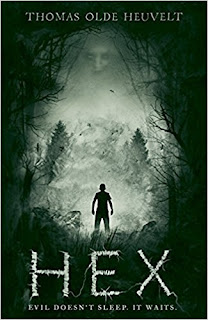
book cover Hex has a very King-like feel. The quintessential American little town, the close knit community, the apparent order and control, the breaking of chaos and the reveal of the true face of humanity. And yet, the inspiration for the story came from Roald Dahl's The Witches and it was originally about a little Dutch town. However Thomas Olde Heuvelt saw an opportunity while reviewing the English translation of the book and updated it for an American audience.

The premise is interesting enough. Imagine a modern town that is also haunted by the 350 year old witch that cursed it. People have molded their lives around the witch, using the Internet and technology to monitor her and hide her from the world outside their little town. And when something goes wrong, it goes very wrong. However, I loved that the end was not the typical American horror story, in which the baddie does unspeakable things and the heroes suffer and maybe prevail after grievous losses. It's difficult to talk about it without spoiling the ending, so you will have to read the book and remember me when Katherine displays shock.

Now, I can't say I loved the book. It is well written and the characters are compelling enough. However, it did feel like someone was excited to write a story in the American way, and that is exactly what I did not expect from the author. I mean, I've read The Boy Who Cast No Shadow and that was both powerful and fresh. Hex is not very long, though, and easy to read. Perhaps its best feature is also its worst: it is predictable. You read it and it's like those supposedly funny fail videos where you know something is going to happen, you can even guess what it is going to be, but you are still watching to see it unfold. If you like Stephen King, you will like this book.

Friday, 6 October 2017

Counterfeit Sky - Failure

As an experiment, try to find this video without knowing the name of the song or of the band. I tried so hard until my brain just gave up and remembered the name of the band all by itself. So here is the video. Now I can always find it when I need it. Cool song and video, I think.


And so that other people can find it: it's a music video about an astronaut crash landing on an alien planet and finding his own dead bodies and more versions of himself continuously falling and dying in different ways.

Obsidian and Blood, by Aliette de Bodard

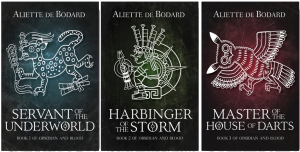
book covers for the three bookds Obsidian and Blood is a collection of all the works in the Aztec magical universe created by Aliette de Bodard. It contains the three books Servant of the Underworld, Harbinger of the Storm and Master of the House of Darts, plus three short stories (which perhaps you should read first). The stories can be found online, if you want a free taste.

Now, while I enjoyed the books, I felt a little cheated. In fact, these are not fantasy books as much as policiers, just set in the tiny and magical Aztec world. Acatl, priest of the Dead, is trying to solve the mystery of various murders and magical transgressions. He is driven, moral and relentless, willing to sacrifice everything in order to save his friends, loved ones and ultimately the world. So it's basically a cop book, only with Aztec gods around.

The writing style is very technical, reminding me of so many other authors that learned the craft in writing classes, with a mentor and a group and so on. However, it was in no way innovative. I felt that the books are the written equivalent of TV movies: professional, but mediocre. And while I stuck through all the books instead of stopping with the first, it's kind of like watching the rest of a miniseries just because you watched the first episode.

The context is the only thing that elevates the book above average. It is an interesting setup to base the stories on Aztec mythology, but I felt that modern sensibilities prevailed and the author chickened out when it came to child sacrifices and ritual torture and so on. They are mentioned, but everybody, whether heroic or villainous, is rational and follows a modern way of thinking.

Bottom line: I wish these were filled with the horror and majesty of the old blood gods, making me feel something visceral and true, more like the short stories and less than the books. As such, these are just police mystery stories set in the Mexica empire.

Monday, 2 October 2017

Debugging in Eclipse

For anyone coming from the welcoming arms of Visual Studio 2015 and higher, Eclipse feels like an abomination. However, knowing some nice tips and tricks helps a lot. I want to give a shout out to this article: Again! – 10 Tips on Java Debugging with Eclipse which is much more detailed that what I am going to write here and from where I got inspired.

Three things I thought most important, though, and this is what I am going to highlight:
  1. Show Logical Structure - who would have known that a little setting on top of the Expressions view would have been that important? Remember when you cursed how Maps are shown in the Eclipse debugger? With Show Logical Structures you can actually see items, keys and values!
  2. The Display View - just go to Window → Show View → Display and you get something that functions a bit like the Immediate Window in Visual Studio. In other words, just write your code there and execute it in the program's context. For a very useful example: write new java.util.Scanner(request.getEntity().getContent()).useDelimiter("\\A").next() in the Display window, select it, then click on Display Result of Evaluated Selected Text, and it will add to the Display window the string of the content of a HttpPost request.
  3. Watchpoints - you can set breakpoints that go into debug mode when a variable is accessed or changed!

For details and extra info, read the codecentric article I mentioned above.

Friday, 29 September 2017

Star Trek Discovery vs The Orville

Discovery vs The Orville Hungry Trekkies, not nourished enough by the latest Star Trek movies, have been treated with not one, but two Star Trek series this fall. One is Star Trek: Discovery, the other is The Orville.

You may be incredulous at first, considering you are likely to not have heard of The Orville at all and, if you did, you thought it was a Star Trek parody. But no. Four episodes into the series it's pretty clear that this is a serious sci-fi opera, with some comedy added for spice. What about the new Star Trek series? Well, it's set before The Original Series, it has the visuals closer to the Abramsverse Star Trek (but without the flares, thank you very much), it has redesigned Klingons and a pretty impressive first two episodes.

It is too early to discuss the plot of Discovery yet as the premise hasn't even been revealed in its entirety. As of yet I can only tell you that I hate the main character. A human female raised by the Vulcans behaves in a way that makes one believe her education was acquired only from Vulcans in Pon Farr. CBS went all in and made the show available on their own CBS All Access network and hired actors like Michelle Yeoh to play in the pilot.

Yet Orville, with clearly less money and with TV actors and comedians managed to do better. The episodes are separate, like in a traditional Star Trek series, rather than a long serialized story. The plot of each episode is related to social or moral issues, like in traditional Star Trek series. People are positive and talking about themselves and their feelings, like traditional Star Trek series. There is comedy, but it is not part of the scaffolding of the stories. It's just a funny crew in a Star Trek clone that's as close as it gets. And if we are at the subject of celebrity actors, episode four has freaking Liam Neeson in a few scenes.

Conclusion: it may go either way, but right now The Orville seems to have done what I thought people would do: renounce the CBS/Paramount property and their money grabbing schemes, but keep faith with Gene Roddenberry's vision. Because that is the soul of Star Trek, not the money thrown by corporations to turn it into an all action and explosions piece of crap. Still, I have hope for Discovery as well. Only time will tell.

P.S. Now if they would only do Andromeda right...

Thursday, 21 September 2017

Blood of Elves (Saga o Wiedźminie #3), by Andrzej Sapkowski

book cover While Blood of Elves is the third work in Andrzej Sapkowski's Witcher series, it is the first actual book, the rest being collections of short stories. The style is the same, the characters the same. What changes is the scope of the story, the size of the described universe.

Is that a good thing? I can't say. While I applaud Sapkowski's attention to historical detail and the way the names are written or spelled in human or elven languages, the action still feels like I'm watching one of those Polish TV plays for children. A lot of dialogue, some exposition, no end to the moralizing stories about the environment and how politicians suck. So I am undecided whether this is a better way of treating The Witcher. However, I can say that the first book in the saga is nothing more than a chapter in a large story. A lot of set up, a lot of discussions, a lot of "almost there, but not quite" and then the book ends when you were starting to wonder what is going to happen. That makes the book incredibly disappointing as a stand alone story and, as I don't intend to read more of the Witcher, kind of a waste of time.

It is similar to one of those Hollywood movies that get split into two parts and it is never a good idea to watch the first part, then wait for a year to see the continuation. While I could read it really fast and there was nothing complex in it other than the political and geographical details, the story is almost nonexistent. I didn't like that at all. To add insult to misery, the book is about Ciri, the princess/witcher/witch, and very little about Geralt who appears mostly in memories and does very little in the story.

Bottom line: unless you are committed to read the entire Witcher series, don't bother reading this volume. It's not that it is badly written, it's that it does nothing but setting up the next books. It is an oversized chapter of a larger story and cannot be entertaining as a stand alone.

Sunday, 17 September 2017

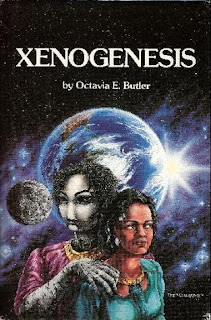
Lilith's Brood (Xenogenesis), by Octavia E. Butler

book cover This book is NOT about vampires. For a long time I avoided reading it because the title so suggested some steamy vampire young adult crap. But no! The book is a hard sci-fi book about the end of humanity, written in a style that I can hardly imagine any man would be able to adopt. And that's a good thing.

Lilith's Brood is in fact a collection of three works (Dawn, Adulthood Rites, and Imago) by late writer Octavia E. Butler. That is why it is so damn long. Since she died, there won't be any more books in the series, so the "Xenogenesis #1-3" label is a bit misleading, just the name of an out of print collection that gathered the three stories together.

The story is about a species of aliens who decide to save the human race after a global war that had doomed it to extinction. The aliens are very interesting, but even more interesting is how the author surfs the edge of defining them as good or evil. Some of the things they do are benevolent and generous, others are, by human standards, insidious and evil. Imagine a benevolent Zerg species coming to Earth. Or a biological Borg with good intentions. Or an intelligent virus that rationalizes its actions as for the better good. It is difficult to keep reading as it pretty much describes the salvation of the human race as a centuries long rape and corruption process by a species that is much more advanced than us, but in very important ways, more animal than humans are. And we are almost helpless. Imagine you are a pet of omnipotent new-age vegans. It's something like that.

I was saying that only a woman could have written about it in this way because the focus is on survival and procreation, on protecting and avoiding death, on how the body feels rather than the mind. I do think that males were presented as either violent mindless rapey idiots or sensitive pacifist weak side characters. The arrogance of the aliens also has a strong vibe of "mama knows best", which explains why males were reduced to enraged murderous states. I mean, that's always the result of that "educational method". But the book is good enough to make you ignore that.

The bottom line is that this is a great book, one that is incredibly detailed and focused on characters, rather than technology or some story arch that has to end at some defined point. It made me think of so many things. I've once had this fantasy of writing a book about people being treated as pets. This is as close as I've read so far. Lilith's Brood made me reconsider the way I raise my dog! It also made me think of the nature of individuality, its benefits and perils, or the definition of humanity. Can you still be human when stripped of all dignity? As I said, while very very good, it is not easy to read. I was sometimes putting the book down and fantasizing on things I would have done if I were some character in the book.

Worth a read, that's for sure.