Tuesday, 6 June 2017

The Summer Dragon (The Evertide #1), by Todd Lockwood

book cover Sagas and trilogies be damned! The Summer Dragon was a really entertaining book and having it end as a mere episode in a larger story that hasn't been written yet is quite frustrating.

Todd Lockwood is mostly known for his fantasy illustrations, not writing, and Summer Dragon is his debut novel. It is an YA story, with a similar structure as so many others: young nobody discovers they have special abilities and are thrown in a world of mystery, wonder and danger, with adults being either weak supporting characters and/or villains, but done right! The heroine - yes, a girl - is thrown into a situation in which politics and culture are forcing her to either be completely passive and submissive or to take action by herself. She doesn't do it with superpowers, but with the knowledge she learned from her father and her own personal courage and ingenuity. In the end she does overcome some pretty insurmountable odds, but it never gets too annoying. If there is a flaw I have to talk about it is the fact that each chapter is written with the same hero's journey structure, with new tension added at the end and character building in the middle. The author is a bit too neat in following the writing guidelines.

I liked that the protagonist is a woman. This is, so far, a perfect feminist book, since she is fighting real issues, social, political and military, using her own skills and in the few situations where she is a love interest she doesn't automatically feel she needs to either reciprocate or condescend and insult her suitor. It is also a book about dragons, but she is the daughter of a dragon breeder, rather than a kid that suddenly discovers there are dragons or other crap like that. The world is not very detailed, but what is in the book is pretty consistent and has a lot of potential.

I don't want to spoil the book by giving details, but there was also something that I felt was a missed opportunity. In an already existing conflict a third party emerges, a super villain, if you will. It was the perfect moment to switch the real source of the "evil" and to reframe an existing war as something that no one participating really understood. As written, it is very difficult to understand why career military men locked in a prolonged conflict dismiss vital tactical and strategic information for silly things like religious fervor or personal greed.

Given the opportunity I would have immediately read the other books in the series. Alas, The Summer Dragon was released just last year and it's the only published book so far. If you want to avoid frustration, wait until Lockwood writes a few more books and then start reading the series. I have great hopes for it.

Jack Glass, by Adam Roberts

book cover There is a cover for the book that writes "Best SF Novel of the Year BSFA Award". I can only assert that it was either competing alone, that they give a prize to all contestants or that the British SF Association doesn't know what a good book is. Its worst flaw is that it is naive. First with its depiction of space. Stuff in the book would not have worked in the 80s, I believe, much less in 2012 when the book was released. The style of the prose seems to emulate works from the 50s and 60s and at first I wondered if it wasn't intentional, like a sort of parody or tip of the hat. Regardless, the book remains naive in almost all aspects, even those of the basic plot, which is not sci-fi, but rather whodunnit and escape from the room stuff.

That being said, Jack Glass is not a totally bad book, either. It presented some ideas that were rather fresh. Using convicts to prepare asteroids for colonization, for example, or having trillions of people living in the Solar System, not on planets, but asteroids and such, the idea that each of these habitats would create their own flavor of religion and culture. But other than these rare juicy details, the rest of the book is quite boring, predictable and bad. The clues to solve the mysteries, rather than being presented to the reader so that they can participate in the solving, are brought in by random plot events, like dreams. People that were supposed to be the best rationalists, Sherlock Holmes style, were being manipulated and educated by ordinary people that somehow knew and understood more. The laws of physics, psychology and sociology are being completely ignored.

Bottom line, a bad book from Adam Roberts, with the occasional hidden gem that doesn't really save the silly plot and ugly narrative.

The case of the bitch and her mysterious disease

So, me and the wife were walking our dog in the park one Saturday evening when we saw this female German Sheppard mutt looking all lost and terrified. The wife, being the heart of us two, points out to me that the dog is probably lost and she looks terrified. Me, not being the heart in the relationship, just hoped her owners would show up. Well, one can't ignore one's heart, as my wife keeps repeating in the hope I am listening, so I end up attaching a leash to the dog's collar and heroically attempting to save the dog.

The plan was as follows. Step 1: take the dog to the vet. Step 2: the vet will know what to do. Additional info: the dog was walking really strange, was terrified of everything, but especially crossing streets and was bleeding from between the legs, occasionally appearing to try to piss and nothing coming out. Suspecting a car hit and maybe internal bleeding, I rushed the dog to the vet I know in the area, who also treats my dog. Imagine doing that with a 20 kilos dog who is afraid of streets, basically.

Step 1 went to shit when I realized the vet was closed at that hour on Saturday. I mean, nothing ever happens to dogs in the weekend, right? I tried calling pet ambulances, they all refused to come, claiming not enough capacity. Finally I called the wife to come with the car and drive us to a nearby non stop veterinarian clinic.

The situation looked like this: female dog in heat (not internal bleeding) which was probably not hit by a car, but walks funny because she is probably not right in the head, first suspected to be 5 to 7 years old, but then age adjusted to over 8, erratically aggressive (although what aggressive meant to the doctor seemed to be a low growl of annoyance). Also, the doctor didn't know any shelters, groups that take care of lost dogs or anything like that. Surely no dogs get lost and found and then brought to vets. He had no idea what to do. So Step 2 went to shit when the vet told us the dog was not microchipped, was probably abandoned and, for all intents and purposes, was now ours, since no one adopts old dogs.

We decided to pay for some tests to figure out what is wrong with the dog and to keep her in the clinic, since she's a big unpredictable female dog in heat and our dog is male. We did that daily, paying a lot of money for it, until around Tuesday, when the doctors decided that the dog problems were probably neurological and that her uterus was malformed and probably would have caused the dog to die in the near future unless operated and removed. I was about to authorize the operation, too, and was thinking of names for the dog. Since our dog is named Tyrion, naturally she would have been Arya, but for the fact the dog was older, so maybe Sansa - she was traumatized and afraid of everything, too. In the end I was going for Lysa - since that was the older crazy aunt in Games of Thrones.

And here comes serendipity. A young woman comes to the clinic and asks if it is possible for dogs to run away from home in order to die. Apparently, her dog, staying with her parents, ran away from home and said parents were too horrified to tell her of that until that day. Stranger still, in the rare occasions that the dog was getting lost, she always returned home, which she now failed to do. No, the girl didn't look for found dog ads (which I posted all over the Internet), she didn't ask around in the park where the dog was lost (where I told just about every dog owner to spread the word), no, she just randomly arrived at the same clinic and asked this question. Of course, it was her dog we were talking about. No, lady, when dogs run away from home they usually go to the vet to get checked out!

So, if and when the dog will get operated or receive specialized treatment for her brain issues - which apparently she had since she was a pup - is the owner's business, and we only offered our financial aid in case it was needed. Happy ending, the dog is back with her owners, with some extra medical tests done and possible solutions for her future well being on the table.

Saturday, 27 May 2017

Samurai Jack is dead!

16 years ago, Samurai Jack premiered as an animated show where a honorable samurai travels through time to destroy the demon Aku, who has taken over the world and made it evil. With Genndy Tartakovsky's genius behind it, this tale of good versus evil never seemed too simple or too idealistic, something movies today and in the future need to learn. However, after only four seasons, the show was not renewed, leaving fans with the bitter sweet conclusion that evil will triumph if no one fights against it, especially in the world of movies and series.

And people fought and the series received its continuation... and its ending, a season 5 that ends in a glorious finale. What comes next is a spoiler for the last season and the show's finale, you've been warned.

Click to show spoiler

For Entertainment Weekly, Геннадий had this to say: This is it. This is the definitive end, and it’s a great end. I haven’t seen it yet, but I’ve storyboarded it, and I think it’s super satisfying, and it should close the door for me for Samurai Jack. … Now, look, there’s 50 years between season 4 and season 5, and if somebody wanted to jump in and do some stories in between, but for me this is the end

Anyway, I really hope Tartakovsky comes with something new soon, something that is just as creative and just as actual as Samurai Jack was. He somehow made a show about a samurai feel futuristic. That's not easy. And even his most childish shows, like The Powerpuff Girls, were great. He will be directing Hotel Transylvania 3 next, but I really wish he wouldn't burn out and stick to movies, especially stupid ones like this, when his shows were the highlights of my youth.

Thursday, 25 May 2017

Cold Magic (SpiritWalker #1), by Kate Elliott

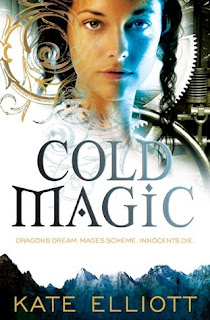
book cover Just look at that book cover. Someone was already imagining the multiple Hollywood movies, or at least a TV series. Yes, it's another young adult story, but this one is different because it is from the point of view of a girl. Besides, I've read several YA books and I liked some of them.
In Cold Magic, Kate Elliott describes a feudal world in which the rulers are either princes or "cold" mages, although there are many other aspects of magic in the world that are briefly explored. There is a lot of history, too, parallel to the European one - if magic was real in the Napoleonic times. For the first quarter of the book I lapped it up. I was curious to see how this young girl manages to untangle the mystery of the things that are happening to her and if she will thwart the powerful people who want to use her and her girl cousin. However, after a few chapters in which kind of the same thing happens over and over again, with no real reason, I was getting restless. Add to this the long descriptions of personal fashion, grooming and judgement on how people look and what it tells about them and I was starting to get a little annoyed. When it all turned to romance, I was simply disappointed. It wasn't that the point of view of the young woman ruined the story, but that it irritated me enough to make me attentive to the plot holes.

Bottom line: I am half curios on how the world building will evolve and how the author is going to describe this alternate magical Europe, but on the other hand I feel like the entire book I waited for something to happen and to make sense, when in fact all characters did things in order to move the story in a certain direction. Instead of being character driven, the plot meanders and the characters drift on it like leaves on a river. I can't empathize with people that lack almost any kind of control over what happens to them, especially since the trope of the young person thrown into a maelstrom of unexplained situations with people that speak in riddles and keep things for themselves is so overused in YA novels and I am tired of it. I will not read the next books in the Spiritwalker series. It was fun for the first half of the story, but then it went downhill.

Sunday, 21 May 2017

Zero Days (2016), a very interesting and well done documentary about Stuxnet

Here is my IMDb review for the film: A gold standard in documentary films and a very interesting story
Once you go beyond the automatic dislike of computer screen hexadecimals turning into beautiful 3D animations, which is the norm in all popularizing documentaries, you can see not only how interesting the story is and how well the film is done, but how much effort came into the gathering of the information in it.

This two hour film describes how Stuxnet changed the world, first from the eyes of malware researchers and how they discovered the worm and how they started to analyse it and realize how advanced it is and what it does, then goes into the political realm, describing how the US and Israel did this to Iran, then narrows down, showing not only how this was something the US did to prevent the Israelis to do even worse things, but how Stuxnet came back to bite its creators in the ass. In the end we are shown the true reality of a world in which anyone can do horrible damage with no attribution while the security institutions keep everything secret and out of public discussion and decision.

A very informative movie, filled with useful tidbits, showing the story of Stuxnet from start to end and to later consequences, interesting to both technical people and laymen alike. Well done!


I particularly liked the idea that the more aggressive the worm got, the less effective it was. Israelis pushed and pushed the US until the malware became more autonomous and the whole operation blew wide open and the Stuxnet worm infected American computers. It was funny to see how scared American agencies were about this new sophisticated malware attacking their systems, while other American agencies, the ones that created it, were prohibited by secrecy to reveal it was them.

I also found really interesting the fact that the most effective versions of the worm were subtle pieces of code that attacked very specific targets and needed a human operative to insert them into the system. The "public" version of Stuxnet, the one that became so visible antivirus people noticed it, that is the version that used stolen certificates and four zero-days exploits, but wasn't the one that actually delayed the Iranian nuclear operations for a year with no one the wiser about what was causing the damage. Blunt tinkering in the elegant code of the initial software led to its discovery and, indirectly, the creation of cyber warfare units in all national intelligence agencies.

Wednesday, 17 May 2017

Sleeping Giants (Themis Files #1), by Sylvain Neuvel

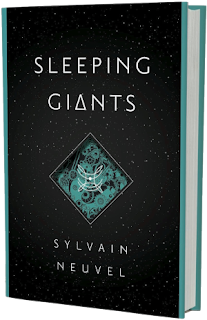
book image Gotta learn to not blindly trust book reviews that appear in my favorite web sites. I mean, they have the right to be wrong (aka to their own opinion). To be honest, I just expected the book to be better, I wasn't particularly upset with it. The review called it "the next Martian"; it's not even close. It's a completely different style, mood, idea and quality. But, that being said, I enjoyed it. Better still, I learned an interesting and probably valuable lesson out of it.

You see, Sleeping Giants is the closest I've come yet to a "hand held" book. The story is told exclusively through interviews and records of discussions. I mean, there is one scene where the heroes have to disarm some guards and instead of going quiet, they keep talking into their sat phone with someone so we can read what happened. It wasn't bad, but I sincerely hope that the rest of the books in the Themis Files series are not the same, although I am pretty sure I will not read them. However, I've learned from this. Even if you are shit at writing scenes, you can write a book that is being told through dialogue and short personal entries and tell the story.

So the story that Sylvain Neuvel tells is about us finding pieces of a giant alien robot and finding out how to operate it, even if the way it functions seems incomprehensible. I've covered the style, so now I have to tell you about the plot, which is naive to say the least, but enough to suspend your disbelief as you read the book. The beginning promises a lot more than the ending provides and, while I understand there is another book, I don't really care how the story ends.

Bottom line: a little fun sci-fantasy, with no real consequence or worth of mention. However, Sony did option the rights for the book, so who knows when we're going to get an alien robot defending the Earth against Godzilla movie, or whatever crap like that.