Monday, 12 September 2016

BitTorrent and Avast [Win32:Evo-Gen (Susp)]

Today the free antivirus Avast reported my BitTorrent installation as infected with Win32:Evo-Gen (Susp). It also promptly removed the executable of the program. I tried to reinstall it, also to have the same happen to the installation program. I've reported a false positive (I hope it is) for BitTorrent Stable (7.9.8 build 42577) and then I added *bittorrent* as an exclusion pattern in Avast. I could then reinstall the program, retaining all of the settings and torrents in the download list.

Sunday, 11 September 2016

The Alcatraz series, by Brandon Sanderson (Books 1-4)

four book covers I got this bundle of four books in the Alcatraz series, by Brandon Sanderson, and since I loved all of his books so far, I enthusiastically started to read them. First, you need to understand that there are five books in the series, with The Dark Talent just published. I think it pays to wait until you have it before you read the whole thing, since it pretty much reads as one long story (unless you read the beginning and then immediately skip to the end of each book, heh heh heh!). Second, you need to know that at the beginning the writing will appear waaaay too silly and under par compared to the author's other works. After a while it kind of grew on me, but be aware that it is written mostly for kids. Sanderson even says so in the story itself.

So at first I kind of thought this will be the series that breaks the rule, the one that I would not enjoy reading, and it took some time to shake off this feeling. It feels like the author could not make up his mind on what to write: the obligatory book about writers (after all, the rule says "write what you know", so in the end it's inevitable) or the recently obligatory Harry Potter spoof (which fantasy authors are peer pressured into writing). In the end he wrote something that has both: a story about a boy discovering he has magical powers and also a book filled with meta comments and breaks in the Fourth Wall (the character has the Breaking Talent, see) that shows some of the tools and processes in the writing business.

In fact, the more I read, the more I enjoyed the books. The characters are as always incredibly (annoyingly) positive and there is that Sanderson smartness behind even the silliest of exchanges. He references future scenes, with book and page number (which is amazing if you think about it), he hooks you to a scene then berates himself on using hooks in the book, he uses really silly and out of context details only to use them at full effectiveness a book later. In the end, you get something that children will undoubtedly read with giggling pleasure and that adults (especially those interested in writing) will see as a deconstruction of the writing process.

Now, I still feel the Alcatraz series is one of the lesser Brandon Sanderson books. The silliness sometimes feels forced and the way he writes each book changes slightly, as he experiments with the crazy shenanigans that he started with this series. It's still very entertaining, though. Give it a try, or give it to your children so they can get into writing themselves and make your life a living hell when they grow up :)

Friday, 9 September 2016

The disaster of 9/10

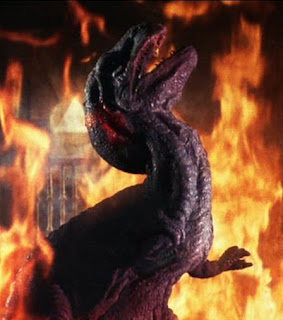
Dinosaur roaring over background of burning buildings I was in some sort of American campus, one of those where they found a gimmick to show how cool they are. In this case it was reptiles. Alligators were moving on the side of the street, right next to people. They would hiss or even try to bite if you got close enough. I was moving towards the exit, which was close to the sea and leading into a sort of beach, and I was wondering what would happen if one of these large three meter animals would bite someone. And suddenly something happened. Something large, much larger than a crocodile, came out of the water and snapped a fully grown adult alligator like a stork snatches frogs. What was that thing? A family of three was watching, fascinated, moving closer to see what was going on. "Are these people stupid?" I thought.

Sure enough, the dinosaur thing bites through the little kid. The father jumps to help but is completely ignored, his sudden pain and anguish irrelevant to the chomping reptile. Other tourists were being attacked. One in particular drew my eyes: he had one of the things pulling with its teeth on his backpack. The man acted like something annoyed him, making repeated "Ugh!" sounds while trying to climb back on the walkway. His demeanor indicated that he didn't care at all of the reptiles, temporary annoyances that stopped him from returning to normal life. At one moment he paused to scratch an itch on his face. His fingers were bitten clean off, blood gurgling from the stumps. He was in shock.

Somehow, a famous actor jumped from somewhere and made it clear that it had been just a show, although the realism of it was so extreme that I felt an immediate cognitive dissonance and the scene switched.

I was at the villa of a very rich friend and there was wind outside. Really strong wind. Nearby wooden booths that were at the edge of his garden were pushed towards me, threatening to crush me against the wall of the building. I went inside, telling my friend that he should take whatever he needs from outside because the wind is going to tear them away. He calmly pressed a button on a remote and an inflatable wall grew around the compound, holding the wind at bay. Cool trick, I thought, trying to figure out if it was firmly anchored to the ground by wires or it got all its structural strength from the material it was made of. It had to have some sort of Kevlar-like component, otherwise it would have been easy to puncture. I calculated the cost of such a feature as astronomical.

We went in, climbing to the second or third floor. Out the window I saw buildings, like near the center of Bucharest. The wind was wreaking havoc on whatever was not firmly fixed. The building across the street was 10 floors tall and apparently someone was doing roofing work when the wind started. The fire used to heat up the tar was now really intense from all the fresh oxygen and smoke was billowing strongly. Suddenly the top floor caught fire, flames stoked by the wind into unstoppable blazes. I called my friend to the window and showed him what was going on. While we watched, floor after floor were engulfed in flames, explosions starting to be heard from within. The building caught fire like a cigarette smoked in haste. I thought that if the wind went through the building, via broken windows and walls, then the a very high temperature could be reached. And as I was thinking that, the building went down. It didn't collapse, instead it leaned towards our villa and crashed right next to it.

I panicked. I knew that on 9/11 the towers collapsed because of the intense heat, but a nearby building was structurally weakened by the towers falling and it too went down eventually. I ran towards the ground floor, jumping over stairs. If the villa would crumble, I did not want to get stuck inside. While fleeing, I was considering my options. The building that went down had people in it, maybe I should head right there and help people get out. Then I also remembered the thousands of people helping after the September 11 that later got lung cancer from all the toxic stuff they put into buildings. Besides, what do I know about rescuing people from rubble? I would probably walk on their heads and crash more stuff on top of the survivors. I've decided against it, feeling like an awful human being that is smart enough to rationalize anything.

As I got down I noticed too things. First there was a large suffocating quantity of white big grained dust being blown by the wind, making it hard to breath. The light was filtered through this dust, giving it a surreal dusky quality. I used my shirt to create a makeshift breathing mask for the dust. Then there were the people. A sexy young woman, short skirt, skimpy blouse, long hair, the type that you see prowling the city centers, was now crawling on the ground, left leg sectioned just under the knee, but not bleeding, instead ending with a carbonized stump, like a lighted match that you put off before it disintegrated. I saw people with their skins completely burned off, moving slowly through the rubble, reaching for me. Some where nothing more than bloodied skeletons, some were partially covered in tar, the contrast of red inflamed burns and black tar or burned clothing evoking demonic visions of hell. These people were crying in pain and coming towards me from all sides, climbing over the ruins of buildings and cars. The smell was awful. I ran, parkour style.

As I woke up I tried to remember as much of the dream as possible. I still have no idea what I was doing in that campus and how I had gotten there. I was fascinated by the scene with the shocked tourist, as it implies knowledge of human behavior that I don't normally possess when awake. It was completely believable, yet at the same time bizarre and unexpected. Great scene! I've had disaster dreams before, top quality special effects and all, but never was I confronted with the reality of the aftermath (I usually died myself in those). I am certain I made logical decisions in the situation, but at the same time I felt ashamed at the powerlessness, fear and the fact that I was running away. Should I have stayed and helped (and gotten cancer)? Should I have rushed home and blogged about it? Maybe a strategic retreat in which I would have conferred with experts and then maybe got back with professional reinforcements?

What felt new was that while having all those random thoughts and running, I wasn't really thinking of my life. I wasn't considering whether my life is worth saving or what the purpose of my running actually is. It wasn't thinking at all; just running. It was visceral, like my body was on autopilot, taking that stupid head away from the danger before he thinks itself to death. Considering it was a virtual body in my actual head, that's saying something. I am not just sure what.

Anyway, beats the crap out of the one with being late for the exam, not having studied anything...

Wednesday, 7 September 2016

On Copyright

Copyright is something that sounds, err... right. It's about keeping the profits of the sale of work to its author. If I write a book, I expect to get the money from it, not somebody who would print it and sell it in my name. With the digital revolution, copy costs collapsed to zero: anyone can copy anything and spread it globally for free. So what does that mean for me, the author? Well, it sucks. The logical thing for me is to try to fight for my rights, turn to the law which is supposed to protect me, find technical ways of making copying my work harder, preferably impossible, going for the people who are chipping away at my hard earned profits.

However, that only makes sense from the author's point of view, specific to their work, outside of any context. Now, imagine a system that allows me to anonymously share anything to anyone, while they also can get it with no chance of being identified or even detected. Me, the author, can see that my work is being circulated, but I can't stop it or determine who is spreading it. My only recourse is to try to dismantle this devilish system that destroys my living, with the full support of law and various companies that want to get their share of the profits. And here comes the context: in order for me (and the entire media industry) to be able to protect my way of life I need to actively fight against any method that allows anonymous and/or secret sharing of information. In fact, I would be fighting for a global system of surveillance and censorship.

As you have seen, I tried to present the situation from the standpoint of the author. I feel for the poor guy (less for the snakes that get most of the money by controlling distribution and marketing), however it is clear that I can't be on his side. The hypothetical system that I have been describing kind of exists right now in various forms and media companies are making efforts to thwart attempts to make it more user friendly and more widespread. What we see today is the logical continuation of the situation. Forget intelligence companies looking for terrorist threats. Forget tyrannical states trying to find dissidents. Forget the political correctness police trying to expose and shame people for their beliefs. The real money is in stopping people distributing knowledge for free and it has direct (and dire) implications on our ability to speak freely.

Note: I used the expression "speak freely" rather than free speech, because free speech is not actually free at all. Read about it and you will see that is a completely different thing than the ability and permission to express yourself without repercussions.

Of course, I am not the first one to have thought of that. In the world it often has become more effective to use copyright in order to censor things you don't agree with. Just google it and see. Every time you hear something about economic accords, freedom of information, net neutrality, they are all talking about the same thing, only from different angles. The war is active, in full swing, with all of us possible casualties, yet few people are even aware of it. Oh, I am not saying that you can do anything about it... or can you?... but at least you should know about it.

Saturday, 3 September 2016

The demise of the personal technical blog

No, it's not about mine, although this blog has had its ups and down. What I want to talk about is the list of blogs I am following and how it (d)evolved.

When I was an enthusiastic beginner in software development I was hunting for interesting blogs that would give me valuable insights into the minds of good developers, the quirks of frameworks, the hidden tools and processes that would make my life better. I was adding blog after blog to my RSS list. Later on, I kind of stopped. I had things to do, work to be done and unfortunately went through some jobs that were not conducive to learning. Perhaps seeing myself as an expert also hindered enthusiasm in learning (note to self: don't do that!). The obsolescence of the tool I was using to read RSS with and the death of Google Reader also did not help. So recently I just went back to that list of blogs and started organizing it with a new tool. I use Feedly now, in case you were wondering.

Today I had an epiphany. I have over 150 blogs that I am "following", 100 of which are software related, yet only very few of them are actually spewing content anymore. In my three year hiatus from blog reading most of the technical blogs just ... stopped. Some of them just plain vanished, complete with content that I had linked to in my own articles. At that time I was considering blogs as permanent as you can get. I mean people just write stuff for the heck of it, so others can read and learn. There would be no reason for any of this to disappear - there are still pages from 1990 active on the Internet, for crying out loud! So what happened?

One theory is that blogs were created as representations of a person's evolution. For example you are a good WPF programmer and you create something like Dr. WPF's blog. When you stop doing WPF (because Microsoft dropped the ball with it!) you stop writing. Perhaps the author still blogs in other places, other blogs that are thematic, I don't know. Another theory is that people just blog at a certain stage in their life; it's like a quarter-life crisis. When they mature, people stop blogging (which says something...). Maybe the social media explosion pushed people away from personalized platforms and they do all their publishing on Twitter, Facebook, LinkedIn, Medium and so on. As the IT industry moves at an ever increasing pace, the blogs may turn into antiquated relics that are obsolete by the time several posts have been published.

I feel sad either way. When I started blogging, people would come to me for help. After all I started the site years before StackOverflow arrived on the scene. I would write about programming, books, anime, life, personal ideas, jokes, space, science, rants, whatever. It happened several times that I was looking for a solution to a problem and found myself explaining it in an older post. People still praise some posts because they refer technology that is maybe a decade old. Others for getting the full picture on how I got to the end result. So for all these vanishing blogs, I feel a sense of loss for all the knowledge that was lost, for all the voices that turned silent.

I know that as a blog dies ten others appear, but there is no sense of origin anymore, no chronological timeline of the evolution of the person writing. I can even go down the "they are not making them like they used to" road. For me a blog would have functioned as a sort of resumé of someones's work. If I liked an article, I would look at others, maybe subscribe. This way I would be connected not with a concept, but with a person: as they grew, I grew. And SEO be damned, I don't care people don't discover my blog anymore because Google can't make up its mind on what I am actually writing about. When people do come, they see me, not just disparate out of context solutions to their 5 minute problems.

So I wrote this article to express my sorrow. I guess that I miss my friends, even if they never knew me.

Thursday, 1 September 2016

The Emperor's Soul, by Brandon Sanderson

book cover The Emperor's Soul is set in the same world as Elantris, but for all intents and purposes it is a standalone story. It's not a full size book, but it's a bit longer than a short story. In it we find a type of magic called Forging, by which someone can carve and use a complicated seal to change the history of an object or, indeed, a soul. The forging needs to be very precise and as close as possible to the actual history of the target, otherwise the magic doesn't "stick". So what must a brilliant forger do in order to do the forbidden soul forging? They must know their target so intimately that they can't ultimately hurt them.
An intriguing idea, yet Brandon Sanderson does what he does best and focuses on the characters, while the story itself reveals the underlying motivation of each and how it affects the final outcome. The descriptions are minimal and the ending is optimistic and personal as Sanderson often likes his finales.
Since the story is short and I had no trouble reading it in a single evening, it is almost a pity not to read it, even if in itself is just a tiny "what if" tale and offers nothing spectacular.