Thursday, 3 January 2013

TV Series I've Been Watching - Part 13

You know the format, let's get this out of the way. First, the series I've already been talking about:


  • Doctor Who - a weird Christmas special introduced another companion. She is cute and perky and doesn't take commands well. Also, she dies twice already. It doesn't seem to stop her.
  • Torchwood - no Christmas special and no news on a fifth season. I wonder if it will ever reappear.
  • Criminal Minds - still on hold, but not totally rejected yet.
  • Dexter - A weird seventh season sees Dexter in love, running away from mobsters and being helped by his police sergeant to cover up kills or even commit them. Then it all ended in a ridiculous fashion. Hint: watch Dexter's face when Deb jumps at the recently shot person in the last episode: it seems to say That is NOT how this is done! Stop it, just stooop!
  • Fringe - Fringe is not better. I still watch it in order to avoid sci-fi withdrawal symptoms.
  • True Blood - I can't wait for season 6. I do fear for its quality, but I also have high hopes.
  • Weeds - the series has ended, finally, when all life has been squeezed out of it. I am glad it is over.
  • The Good Wife - season 4 is running strong... ish. There are some new ideas introduced in the show that don't really fit well or seem to be needed in the picture, like Kalinda's husband.
  • Haven - season 3 of Haven pits Audrey against a killer that takes people's skins. And she is also to disappear on a certain date in order to stop the troubles. And she is also courted by two guys who are insanely in love with her. What is a girl to do?
  • Lost Girl - removed from my watching list.
  • Falling Skies - season three has not started yet. I am curious how it will continue. Plus it's sci-fi.
  • Southpark - some funny episodes in the October batch. Could have been better. Still good.
  • The Killing - still on my watch list, being a police show and all.
  • Suits - third season is about to start. It doesn't make much sense, but I like it.
  • Breaking Bad - the fifth season has ended and there will not be a sixth. Still haven't had the inclination to watch it.
  • Californication - the sisth season is about to begin. I can't wait.
  • Beavis&Butt-head - It seems the show was quietly axed. I haven't heard anything about it for a long time.
  • Homeland - I've seen two seasons of Homeland and it's pretty cool. Claire Danes is a bipolar CIA agent that fights to prove an American soldier rescued from the Talibans has been turned. She is also in love with him. Not much sense when you put it that way, but a lot of tension. The show is another American adaptation from an Israeli show.
  • The Walking Dead - pretty hard stuff added this season, making it interesting again. Some characters even die! Almost got to "want" status.
  • Game of Thrones - the show follows the books faithfully, even when removing some bits or rearranging others. However I feel it failed to fully capture the atmosphere of the book. We'll see how it goes.
  • L5 - no second episode for a long time now and with the current economic climate, I doubt it will continue. Too bad.
  • Mad Men - season six is to premier in 2013. I will keep watching it, because it is just great.
  • Misfits - all new characters in Misfits, with some stories interesting, but now more towards shocking and/or disgusting. I've removed the "want" status from it, because the quality of the show is not as great as when it started.
  • Sherlock - the third season of the series will begin probably late 2013. I liked it, even if a bit too... Moffaty? I really don't want to see more and more people acting like Doctor Who. One is enough.
  • Spartacus - Vengeance - War of the Damned will start soon, in January. Too bad it ends the show, but then again, maybe it will be something meaningful and slim, without boring filler episodes.
  • My Babysitter's a Vampire - vampire teens, with seer and wizard friends and fighting against the evil in their highschool? It's silly, but at least it knows it is silly. I watch it because it is easy fun.
  • Continuum - a second season has been confirmed, but I don't know when it will start. Rather boring, but sci-fi, you know.
  • Copper - a BBC America drama about Irish immigrants set "Five Points". I really liked it, with its depiction of rampant corruption and racism and classism at the beginnings of the city of New York.
  • Longmire - a second season has been confirmed. I really like the show, even if about a rural cop in the middle of nowhere.
  • Political Animals - it feels interesting and profound, but it is not really so. The impression is strong, though, and I may still had watched it if it weren't cancelled.
  • The Newsroom - my wife loves this. I will watch the second season, but I can't decide if I like it or not.

And now for new shows:

  • 666 Park Avenue - A show about the devil! I haven't started watching it, and it was cancelled already.
  • A Young Doctor's Notebook - This is not really a series, but a mini series. Four episodes, each 20 minute long, about a Russian freshly graduated doctor coming to work in a really remote village. The show is brutal and funny at the same time. I doubt there will be a second season, but this one is worth it. Starring John Hamm and Daniel Radcliff.
  • Arrow - I watch this, even if I don't really know why. It is yet another superhero series where the main strength of the guy is that he shoots arrows. I can't recommend it.
  • Beauty and the Beast - Incredibly beautiful people acting as both beauty and beast in this ridiculous show that attempts to place the story in modern times. The beauty is, obviously, a cop.
  • Blackout - God know I tried to like this show about political and personal corruption in England, but I couldn't. It starts bleak and intense, but quickly devolves into the surreal.
  • Battlestar Galactica - Blood and Chrome - so far William Adama is introduced as a young and cocky pilot in a series of webisodes. The show has everything I loved about the first two seasons of BSG 2004. I can't wait for more.
  • Elementary - the American Sherlock doesn't look or feel at all like a Sherlock. Instead it looks and feels exactly like so many US shows about gifted people helping the police. I still watch it, but the show is really not what it should have been.
  • Emily Owens M.D. - I was caught into one of those times when one wants to see a true doctor show, with actual cases and medical dilemmas. No. Instead this crappy show seems like the poor brother of Gray's Anatomy, with those silly happy songs in the background whenever the female protagonist speaks with other women that are not her evil boss or highschool nemesis (I am not kidding, they added the highschool nemesis thing)
  • Hatfields and McCoys - This American Civil War miniseries was filmed in Romania and stars Kevin Costner. I really wanted to see it, but didn't get around to it, yet.
  • Hit and Miss - A new show I really know nothing about. Six episodes so far.
  • Hunted - Oh, Melissa George as a secret undercover agent (and I do mean undercover). Beautiful, smart, trained to kill and yet fragile as a woman, she leads the show well until... it is put on hold! BBC really screwed up abandoning this show. Cinemax is in negotiations to continue doing it, in collaboration with BBC. Fingers crossed.
  • Last Resort - The show started really well. An American submarine is ordered to nuke Pakistan, but through a secondary network. They request that the order be sent via the primary network, and they are shot upon. They manage to escape and hold fort on a remote island, threatening to launch on any country that even approaches the island. A great premise with very good actors. Unfortunately, the show started to lag a little, then suddenly was cancelled. I would like to believe that it was a nerve they touched with the script, but more likely there are too many stupid people deciding to watch reality shows instead.
  • Made in Jersey - they tried to make "Working Girl" a series, with a New Jersey girl, no less, making it as a lawyer in the big city. It was a complete flop and it was quickly cancelled.
  • Parade's End - another miniseries. The trailer looks really promising and I haven't read the book. As soon as I watch it you will know.
  • Primeval - New World - I can't really say I don't want to see it. It is the American continuation or spin off from the British Primeval show. But it just feels bad in every way, even if Zane from Eureka stars as the lead character.
  • Restless - a miniseries. A young woman finds out that her mother worked as a spy for the British Secret Service during World War II and has been on the run ever since. The synopsis sounds interesting. Two episodes so far, that I have yet to watch.
  • Revolution - can you imagine a sci-fi show that I refused to watch? This is a horrible show, something that combines Xena with Flash Forward. Yes, it is possible. And it sucks!
  • Ripper Street - this is not yet another Jack the Ripper show, instead it is set just after the killings stopped. A bit like Copper, with the police force of the time solving gruesome murders. Haven't got around to watch it, but it might be nice.
  • Secret State - a British miniseries starring Gabriel Byrne. Four episodes, rather captivating, but lacking a proper resolution. Not to mention a happy ending, which British seem to avoid completely :)
  • The Fear - A Brighton crime boss turns entrepreneur and then he goes crazy. Like mentally ill crazy. I haven't started watching this miniseries, but it might be interesting.
  • The Mob Doctor - another promising series that gets cancelled for no good reason. This doctor woman is forced to work for the mod in order to get her younger brother out of debt. She is a brilliant doctor and she has to jumble her official cases with the off the ledger ones. Really interesting, even if a bit bland.
  • Transporter - they decided to do a Transporter series. I couldn't get through half of the first episode. Everything that Jason Statham did well in the show, the ridiculous and pompous ass they placed as a lead did wrong. Every good redeeming quality of a movie that, let's face it, wasn't that great is lacking here. Avoid this waster of time!
  • Vegas - Well, if we have to watch series about cops, at least let them be good ones. Vegas is a good alternative to Longmire, with the action set in the early years of Las Vegas where a farmer and former MP gets to become the sheriff of the town. Interpreted by Dennis Quaid, his character and the local mobster, also well interpreted by Michael Chiklis, make this series interesting and worth watching.
  • Wizards versus Aliens - OK, go ahead: laugh! I did watch a TV series made exclusively for young children where a family of wizards fights a ship of evil aliens set to consume every bit of magic in the galaxy. It is an alternative to The Sarah Jane Adventures, only even sillier. I had fun.

There are several miniseries and shows that just arrived on my radar. No point in discussing something I know nothing about, yet. So far a lot of the shows I loved were cancelled, while stinking refuse of TV series thrive. I am almost to the point of not caring anymore. I hope my short list (yes, I was humblebragging) will help you decide which shows to watch or not watch.

Until the next post in the series about series!
Sunday, 30 December 2012

The (forced) mobile designation for the iPad on Blogger

I was looking for something on my blog using my iPad and I noticed that the format of the blog was horrible. It used a "mobile" mode by default. That meant no Javascript, fixed width, etc. Pretty nasty. There is a link at the bottom of the page that says "View web version" which changes the "m=1" parameter in the query to 0, which makes it accessible as it should have been.

I will be investigating this and how to address it. Meanwhile, there is the workaround of clicking the link mentioned above.

A spectacular, if nothing else, chess game (Wing Gambit)

I want to present to you a game I had last night that was both spectacular and really silly :) You know when you look at chess master games and you are either bored by their precision or befuddled by their ingenuity? Well, this is only a really good show, the equivalent of big budget action movies.
1. e4 c5 2. b4 {The Wing Gambit, a weird anti Sicilian move that I want to
master.} cxb4 3. a3 bxa3 4. Bxa3 {At this point White has control of the
center and a developed minor piece. The rook also has a semi open file
available.} a6 5. Bc4 d6 6. Nf3 e6 7. O-O Be7 8. d4 Nf6 9. Re1 O-O 10. Nc3
Nc6 {Even if I wrote a blog entry on the Wing Gambit, I remembered nothing
and my opponent was so terrified that he tried to protect everything with
unnecessary pawn moves.} 11. e5 {I had no plan and it shows. I was planning
to take on e5 with the rook, eventually, or free my queen by actively
moving the knight on f3.} Ne8 12. Bd3 d5 13. Bb2 {I've decided that I
needed that bishop and moved it to protext the defenceless knight. However,
that is no longer an active square for it.}

(13. Bxe7 Qxe7 14. Na4 Nb4 15.
Bf1 b5 16. Nc5 {The computer suggested this weird continuation, were both
knights are trying to find outposts in the opponent's teritory.})

13. .. f6
14. Nh4 {I had come up with a daring stratagem, enacted in the next few
moves. Can you spot it?} Nxd4

(14. .. fxe5 15. Bxh7+ Kxh7 16. Qh5+ Kg8 17.
Ng6 exd4 18. Ne2 Nf6 19. Qh8+ Kf7 20. Nxf8 Qxf8 21. Qh3 Kg8 {Houdini
recommends a different approach for Black, something that would have
brought it into an advantageous position.})

15. Bxh7+ {The attack begins
with a minor piece sacrifice.}

(15. Nxd5 Qxd5 16. Bxd4 f5 17. Nf3 {The
computer had other ideas, which were almost as wild as what I was
considering.})

15. .. Kxh7 16. Qh5+

(16. Qxd4 fxe5 17. Rxe5 Bxh4 18. Rh5+ Kg8 19. Rxh4 Qf6 20. Qxf6 Nxf6 {The computer would have equalized quickly
in this situation, a most boring continuation that I refused out of hand. I
didn't check the king to swap a bishop for a knight.})

16. .. Kg8 17. Ng6 fxe5

(17. .. Nf5 18. Rad1 Nh6 19. Nxd5 exd5 20. Rxd5 Qc7 21. exf6 Bxf6 22.
Nxf8 Bg4 23. Qg6 Bf5 24. Qh5 Qf7 25. Qxf7+ Kxf7 26. Bc1 Kxf8 27. Bxh6 Bxc2
28. Bd2 {A violent variation from Houdini, something that you have to check
out because there is a lot to learn from it. However, the game did not go
that way at all.})

18. Qh8+ Kf7 19. Nxf8 {Here I publicly prove my idiocy.
The position before taking the rook was mate in 6 moves. As such, I got
cold feet at the apex of my attack. Just a few more seconds of thought and
I would have seen the continuation that the computer saw.}

(19. Nxe5+ Kf6
20. Qh4+ g5 21. Qh6+ Kf5 22. Qg6+ Kf4 23. g3# {A beautiful ending and
something that I should have seen. A pawn mate, with the king banished to
my side of the board and none of the Black pieces taken except three
pawns!})

19. .. Bxf8 {Now, my win in this game was almost completely the
merit of my opponent. I did wild and beautiful moves, but none of them were
actually accurate. At each point he could have come up on top, if he played
correctly.}

(19. .. Nf6 20. Rxe5 Qxf8 21. Qxf8+ Bxf8 22. Nxd5 Nf3+ 23. gxf3
exd5 24. Re3 {The computer would have quickly simplified the position and
taken advantage of its material gain. It would have made quick work of my
apparent king safety as well.})

20. Rxe5 Nf6 {I believe at this point Black
was considering cornering my queen. It would have required freeing the
rook, though, which was impossible.}

(20. .. Qf6 21. Re3 g6 22. Qh7+ Qg7
23. Qh4 Nf5

(23. .. Nxc2 24. Rf3+ Kg8 25. Nxd5 Qxb2 26. Rxf8+ Kxf8 27. Qe7+ Kg8 28. Qxe8+ Kh7 29. Qe7+ Kh6 30. Qh4+)

24. Rf3 Be7 25. Qf4 Bf6 26. Qb4 {A
long dance leading nowhere. My queen banished and the Black king
protected.})

21. Nxd5 {I saw this move that would have gained a pawn, freed
my rook and removed the only Black developed piece.} exd5

(21. .. Be7 22.
Qxd8 Bxd8 23. Nb4 Nf5 24. Nd3 {The computer would not have gone for it.})


22. Bxd4 Be6 23. Rae1 Bg4 24. Qh4 Qd7 25. h3 Bf5 26. R5e3 Nh7 27. Qh5+ {At
this point I was despondent. I had time trouble, my beautiful attack ended
in a big flop and the only thing I could think of was harassing Black's
pieces in an attempt to catch one off guard and gain the material
advantage.}

(27. Bxg7 Kxg7 (27. .. Bxg7 28. Re7+ Qxe7 29. Rxe7+ Kf8 30. Qb4
Bf6 31. Rxh7+ Kg8 32. Qxb7 Rf8 33. Rc7 Bg6 34. Qxa6)

28. Re7+ Qxe7

(28. .. Bxe7 29. Rxe7+ Qxe7 30. Qxe7+ Kg8 31. Qxb7 Rd8 32. Qxa6)

29. Rxe7+ Bxe7 30.
Qxe7+ Kg8 31. Qxb7 Rd8 32. Qxa6 Rd7 {The computer saw this continuation
which is pretty much forced. An interesting combo, but I doubt I could have
mated the king with only a queen against three pieces. I doubt I could have
won.}) 27. .. Kg8 28. Rf3 Bxc2 29. g4 {At this point I only had one idea
left: moving the g pawn front and use it to mate the king. It was as
transparent as it was desperate, but I think my opponent was completely
thrown off his game by the crazy maneuvres I had used.}

(29. Rc3 Be4 30. f3
Bf5 31. g4 {Houdini would also have pushed the g4 pawn, but with backup and
tempo. Again, something to be learned from that. Check out the wild
continuation it found.} Be6 32. Qe5 Re8 33. Rc7 {threatening the queen, but
also g7.} Bxg4 {completely crazy: this is a queen exchange, but the
computer saw the possibility to gain a pawn in the process.} 34. Rxd7 Rxe5
35. Rxg7+ {two can play that game. See how White is going for the pawns in
this insane position, as well.} Bxg7 36. Bxe5 Ng5 {Again, insane! Why not
move the bishop? because the knight can be developed and a new threat (f3)
can be declared.} 37. Kf2 Nxf3 38. Rd1 Nxe5 39. hxg4 Nxg4+ 40. Kf3 Ne5+ 41.
Ke2 Nc6 42. Rxd5 {White would not have won this, but was crazy game.})

29. .. b5 {His plan, to push his passed pawns and gain huge material advantage
or completely block my pieces from attacking would have worked, but it
needed some preparatory moves on the king side, which were not made.} 30.
g5 Be4 31. g6 {The bishop move came too late. I was threatening mate and
the only option to save the situation was the sacrifice of the bishop.}
Bxg6 32. Qxg6 b4 {Again, Black helps me out with a useless pawn move.} 33.
Re5 b3 34. Rxd5 {Enamored by wild moves I did this. The idea was that if
the queen was not defending g7, I could then take the f8 bishop with yet
another sacrifice and mate at g7. I completely missed that the rook could
be taken by the king, avoiding the mate.}

(34. Rh5 {Houdini went instead
for a safe mate in 7 which I missed, even if my initial plan was to move
the rook to h5, but I then forgot about it.} Ng5 35. Rxg5 Bd6 36. Qxg7+
Qxg7 37. Rxg7+ Kh8 38. Rf5 Bh2+ 39. Kxh2 a5 40. Rh5# {Another beautiful
computer mate.})

34. .. Qxd5 35. Rxf8+ Nxf8 {My always greedy opponent was
kind enough to not see the mate. I had time trouble and no matter the
material advantage, I had no time to finish the game without a blunder such
as this.}

(35. .. Kxf8 36. Qxg7+ Ke8 37. Qxh7 Rc8 38. Qh8+ Kd7 39. Qg7+ Kd6
40. Qg3+ Ke7 41. Qh4+ {The only solution for White was to check ad
infinitum, which was not possible if both sides played well. The game was
lost.})

36. Qxg7# 1-0


The game started as a whim. I wanted to do something, I didn't really feel like anything, so I started a chess game, expecting to lose. I am usually a fan of aggressive, off the book, starting positions so, when I was confronted by the Sicilian defence, I decided to try the Wing Gambit. Now, I know I wrote a blog entry about it, but I did not remember anything from it and it would have been unfair to read the blog entry while playing, so I went with the first three moves and then winged it (get it?).

I want to thank Black for helping me along, as with the silly moves I did it was impossible to win if it weren't for his valuable assistance >:)

There are comments in the game as long as several variations. What I want you to pay special attention to is the variation at move 19. If I would had seen it, and I should have had, the game would have been over in a spectacular fashion in only 25 moves. Other variations show how the game could have ended if Black has played well.

Enjoy!

Thursday, 27 December 2012

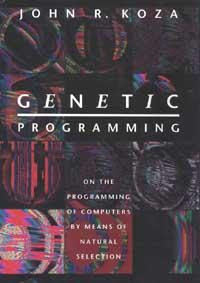
Genetic Programming: On the Programming of Computers by Means of Natural Selection (Complex Adaptive Systems) , by John R. Koza

Book cover Oh, the monster of a book! If you want to learn to do genetic programming, then this is the book for you. If you need an interesting presentation of what genetic programming is, then this book is way too heavy.

Let's start with the beginning. Genetic Programming: On the Programming of Computers by Means of Natural Selection (Complex Adaptive Systems) is a scientific book written by John R. Koza to explain why, how and what to do to make your computer find solutions to problems by using natural selection algorithms to automatically create programs to solve them. This is not a new field and a lot of research has been done in it, but this book takes it almost to the level of encyclopaedic knowledge.

First, Koza submits the idea that genetic programming can be used in most problems where computers are been used. That's a bold claim, but he proceeds on demonstrating it. He takes problem classes, provides code to create the programs that solve them, shows results and statistical analysis on the results and explains what the algorithm did to create said program at specific iterations. That's a lot to take in. If you are working on a program and you are using the book, you are more likely to find it extremely useful, both as a source for information and as a reference that can always be consulted.

However, if you are a casual reader like myself, reading all that code and statistical analysis in the subway can be difficult. And it's a lot of book, too. So, after some consideration, realising that I have no current project on which to apply the knowledge within the book, I've decided to stop reading it. I got to about a quarter of it, so I can safely say that it is a very thorough and well written book. You just have to need it in a certain way.

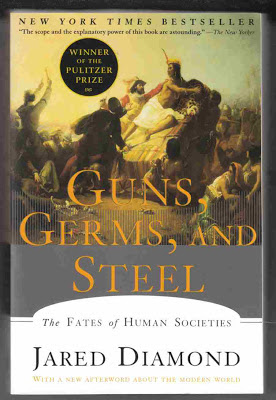
Guns, Germs, and Steel: The Fates of Human Societies , by Jared Diamond

Book cover

I have to say that most of the books I start reading, I am also finishing, no matter how bad they are. I will not be finishing Guns, Germs and Steel, but not because it is a bad book, but because it is too thorough.

I know, it sounds bad for me, but this book, as with the next one I am going to review, are true science books, going through all the arguments, all the proof, anecdotes and theories before making a point. It is not an overly large book, but each passage has meaning and there is a ton of data that must be assimilated in order to be able to say I read the book. Alas, I don't feel like assimilating this much and reading it to the end, just in order to pretend I've read it would be pointless.

The book, written by Jared Diamond, is trying to explain why some regions of the world are more developed than others, why some people are oppressed, while other are the oppressors, why some people get along fine having farms and cities and a thriving economy while others are fighting to stay fed or secure. The author immediately dismisses the idea of racial superiority. Given the biological incentives to stay alive and the selection process that still goes on in less developed areas of the globe, it would be silly to consider those people genetically inferior to well fed Westerners from countries where the leading cases of death are random diseases or accidents. So the reason must be something else.

Having done a lot of living and studying in Papua New Guinea and Polynesia, he has direct knowledge of the way people live there and extensive knowledge of their history. Especially Polynesia he considers a rich bed of "natural experiments" as the many islands have spawned numerous social, political, military and food systems that eventually had to interact. He doesn't stop here, though, giving examples from all parts of the world, the native Americans, Africa, Eurasia, etc.

As far as I could ascertain reading only half of the book, the reason the world looks like it does today is because of a lucky assortment of domesticable animals and crop plants that appeared in the Fertile Crescent. The advantage of such a food surplus allowing for all kind of social and administrative developments was too great to compete with. The culture that spawned from that area quickly overwhelmed the world. In the few areas where resistance appeared, technological advances, immunity to disease that they would still spread and the general historical knowledge gained from the written word made the dominance of said culture a certainty.

For a sociologist, a historian or a palaeontologist, this book should be a must read. It explains a lot, using a lot of arguments on very well documented facts. The style is sometimes too formal, eventually repeating some questions and answering them with overwhelming detail, but none of it is superfluous. As such, it was an interesting read, but a very difficult one. Something that would have ended up eating a lot of time and yielding little lasting knowledge.

So, having faith that I got the gist of it and hoping that maybe I will watch the PBS documentary based on the book to get to the end of it, I will end by recommending it to anyone in the field, but not so much for a casual reader.

The Center of the Cyclone: An Autobiography of Inner Space, by John C. Lilly

Book coverI wanted to read this book as I knew the author experimented with LSD and sensory deprivation tanks. He was the inspiration for the brilliant film Altered States, which I enjoyed immensely. The third book of John C. Lilly, The Center of the Cyclone starts as an intense book, an exploration of the deep mind using arcane and sometimes forbidden techniques. A magnificent beginning... and a horrid ending.

Let me start from the beginning. Lilly is a psychoanalyst and a neuroscientist at the same time, perfect skills to explore and understand the limits of the human mind. He first starts his experiments with dolphins, trying to understand them and communicate with them. He starts an entire institute in order to research this field, but the book is not about that, but about the period starting with LSD experiments. At the time he begins taking the drug, it was legal. Parties were held where people would share the experience and entire schools of therapy were using LSD to facilitate access to the mind.

Having previously tried experiments of sensory deprivation, a sort of shutting down of all outside stimuli in order to explore inward, he attempts to mix the two techniques: LSD and sensory deprivation tanks. Something opens up and he gains access to repressed memories, deep understanding of self and incredibly fast and precise advances in pinpointing psychological hurdles, trauma points. Till this point, I have gobbled up the book, resonating profoundly with the scientific method of exploration aided by chemical substances that eliminate the barrier between consciousness and subconscious. But then it all changes.

If you intend to read the book and make up your own mind, I suggest you stop reading the review now and start with the book. I am going to express my own opinions on what I read there.

What I think happened is that Lilly had the spiritual openness that allowed him to connect empathically with himself and others, something I believe resides in the right hemisphere of the brain. This openness is facilitated by the catholic upbringing that he is subjected to as a child. He himself, under the influence of LSD, retrieves a repressed memory inside a church where he starts seeing angels flying around. He confesses this to a nun and she, bitchy as she was, gets terribly upset and tells him that only saints can have visions, not a seven years old boy. This makes him forcefully lock the door that he had opened in himself. But now, after he has dedicated himself to science and logic, he stumbles upon this drug which unlocks the memory and so the initial skill.

This should have been a momentous occasion, something to combine perfectly the scientific mind with a strong spiritual/emotional side. Unfortunately, he was truly unprepared for it all. From a scientific book, it quickly devolves into yogi and Eastern spiritual practices, combines knowledge gained from experiment with hearsay from ancient texts, mixes hallucination with perception. He acknowledges that he started writing the book, then, after experiencing all of this spiritual avalanche, he decided only the first three chapters were worth keeping. Unfortunately, those are the first three chapters that I loved and that made sense.

It is not just my own subjective disgust for his abandonment of reason that makes me think the book follows up with personal involution, but also the way the book is structured, the writing style, the use of information at the end which had not been introduced previously... it all gets worse.

Now, he is the second scientist I've read that reports some sort of mental or at least emotional connection at a distance, the first one being Kary Mullis, who also seemed rather wacky and experimented with drugs. I really wanted to believe that, as well as many of the extraordinary things reported in the book, and wanted to explore them for myself. But now... I am not so sure. Be it the LSD or some sort of giving up to the emotional side, I see this book as a diary of going bananas and not realising it.

That doesn't mean that the book doesn't contain valuable knowledge. The fact that, single or under guidance, the man could access hidden memories and background "programs" after the first LSD experience makes the entire business of psychotherapy laughable with their lengthy discussions and careful probing. Various methods to access the trance necessary to explore your inner spaces that don't even involve chemical aid (like the looping of a word and listening to it until entering the desired trance state) I bet are perfectly functional. Also, there was one collaborator of Lilly's, Ida Rolf, that used a technique combining deep tissue massage and trance to unlock the repressed memories that affected body stance.

Many more interesting and very useful facts are hidden in the book. Alas, it is difficult if not outright impossible to separate wishful thinking from actual fact, garbage from science. Or maybe, who knows, I am so biased that I can't understand some essential truths in the book. I guess it is up to you to read the book and decide for yourself. I loved the beginning and loathed the ending.

Wednesday, 12 December 2012

Forge of Darkness, by Steven Erikson

I really wanted for Forge of Darkness to be great, something that would wash away the disappointment of the tenth and final book in the Malazan Book of the Fallen. And, in a way, it is. However, with increases in the inner philosophical monologues and a downplay of magic, with a plethora of characters that, for anyone not reading (or remembering, like me) the entire Malazan series, don't yet make sense, it felt raw, pretentious, more in line with Steven Erikson's admission that after 20 years of writing, the voices have stopped nagging him (for a while at least, as evidenced by this book). If this was supposed to be a book to be read, understood and loved, then I cannot see it as a success. If it was only a way to unload the chaos of characters demanding voice in the author's head, then it is quite a realization.

I won't describe the plot in detail. Enough to say that it is all happening in the Tiste realm and it is the story of the beginning of the high magic used in the Malazan cycle. The Azathanai, magic creatures of unknown potential, start interacting with the world on a more personal level. Draconus marries a queen, while K'rull starts bleeding magic as a gift for anyone to use. Eleinth break open into the world and gates for the major flavours of magic are opening as a result of Draconus' love gift. Through all of that, the division of the Tiste and the break of civil war are preparing to shatter the realm of Kurald Galain.

I imagine the second book will be a lot more active, with magic breaking out wild in a world unprepared for it, however the first was more about presenting characters (a zillion of them) and setting the stage. My impression was that, even if Tiste people live for hundreds of years, not every soldier and common man can have pages of internal monologues about the philosophical aspects of living. That is the biggest failure of a book that is otherwise brilliant. I will continue reading the Kharkanas cycle (I doubt it will end as a trilogy), of course, but I am starting to ask myself when the next book of Ian Cameron Esslemont will come out.