Thursday, 27 December 2012

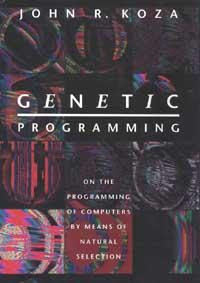
Genetic Programming: On the Programming of Computers by Means of Natural Selection (Complex Adaptive Systems) , by John R. Koza

Book cover Oh, the monster of a book! If you want to learn to do genetic programming, then this is the book for you. If you need an interesting presentation of what genetic programming is, then this book is way too heavy.

Let's start with the beginning. Genetic Programming: On the Programming of Computers by Means of Natural Selection (Complex Adaptive Systems) is a scientific book written by John R. Koza to explain why, how and what to do to make your computer find solutions to problems by using natural selection algorithms to automatically create programs to solve them. This is not a new field and a lot of research has been done in it, but this book takes it almost to the level of encyclopaedic knowledge.

First, Koza submits the idea that genetic programming can be used in most problems where computers are been used. That's a bold claim, but he proceeds on demonstrating it. He takes problem classes, provides code to create the programs that solve them, shows results and statistical analysis on the results and explains what the algorithm did to create said program at specific iterations. That's a lot to take in. If you are working on a program and you are using the book, you are more likely to find it extremely useful, both as a source for information and as a reference that can always be consulted.

However, if you are a casual reader like myself, reading all that code and statistical analysis in the subway can be difficult. And it's a lot of book, too. So, after some consideration, realising that I have no current project on which to apply the knowledge within the book, I've decided to stop reading it. I got to about a quarter of it, so I can safely say that it is a very thorough and well written book. You just have to need it in a certain way.

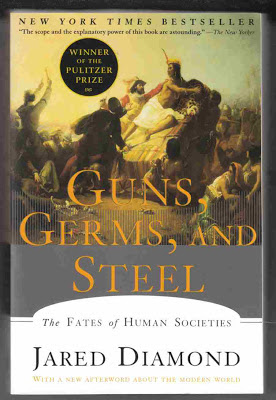
Guns, Germs, and Steel: The Fates of Human Societies , by Jared Diamond

Book cover

I have to say that most of the books I start reading, I am also finishing, no matter how bad they are. I will not be finishing Guns, Germs and Steel, but not because it is a bad book, but because it is too thorough.

I know, it sounds bad for me, but this book, as with the next one I am going to review, are true science books, going through all the arguments, all the proof, anecdotes and theories before making a point. It is not an overly large book, but each passage has meaning and there is a ton of data that must be assimilated in order to be able to say I read the book. Alas, I don't feel like assimilating this much and reading it to the end, just in order to pretend I've read it would be pointless.

The book, written by Jared Diamond, is trying to explain why some regions of the world are more developed than others, why some people are oppressed, while other are the oppressors, why some people get along fine having farms and cities and a thriving economy while others are fighting to stay fed or secure. The author immediately dismisses the idea of racial superiority. Given the biological incentives to stay alive and the selection process that still goes on in less developed areas of the globe, it would be silly to consider those people genetically inferior to well fed Westerners from countries where the leading cases of death are random diseases or accidents. So the reason must be something else.

Having done a lot of living and studying in Papua New Guinea and Polynesia, he has direct knowledge of the way people live there and extensive knowledge of their history. Especially Polynesia he considers a rich bed of "natural experiments" as the many islands have spawned numerous social, political, military and food systems that eventually had to interact. He doesn't stop here, though, giving examples from all parts of the world, the native Americans, Africa, Eurasia, etc.

As far as I could ascertain reading only half of the book, the reason the world looks like it does today is because of a lucky assortment of domesticable animals and crop plants that appeared in the Fertile Crescent. The advantage of such a food surplus allowing for all kind of social and administrative developments was too great to compete with. The culture that spawned from that area quickly overwhelmed the world. In the few areas where resistance appeared, technological advances, immunity to disease that they would still spread and the general historical knowledge gained from the written word made the dominance of said culture a certainty.

For a sociologist, a historian or a palaeontologist, this book should be a must read. It explains a lot, using a lot of arguments on very well documented facts. The style is sometimes too formal, eventually repeating some questions and answering them with overwhelming detail, but none of it is superfluous. As such, it was an interesting read, but a very difficult one. Something that would have ended up eating a lot of time and yielding little lasting knowledge.

So, having faith that I got the gist of it and hoping that maybe I will watch the PBS documentary based on the book to get to the end of it, I will end by recommending it to anyone in the field, but not so much for a casual reader.

The Center of the Cyclone: An Autobiography of Inner Space, by John C. Lilly

Book coverI wanted to read this book as I knew the author experimented with LSD and sensory deprivation tanks. He was the inspiration for the brilliant film Altered States, which I enjoyed immensely. The third book of John C. Lilly, The Center of the Cyclone starts as an intense book, an exploration of the deep mind using arcane and sometimes forbidden techniques. A magnificent beginning... and a horrid ending.

Let me start from the beginning. Lilly is a psychoanalyst and a neuroscientist at the same time, perfect skills to explore and understand the limits of the human mind. He first starts his experiments with dolphins, trying to understand them and communicate with them. He starts an entire institute in order to research this field, but the book is not about that, but about the period starting with LSD experiments. At the time he begins taking the drug, it was legal. Parties were held where people would share the experience and entire schools of therapy were using LSD to facilitate access to the mind.

Having previously tried experiments of sensory deprivation, a sort of shutting down of all outside stimuli in order to explore inward, he attempts to mix the two techniques: LSD and sensory deprivation tanks. Something opens up and he gains access to repressed memories, deep understanding of self and incredibly fast and precise advances in pinpointing psychological hurdles, trauma points. Till this point, I have gobbled up the book, resonating profoundly with the scientific method of exploration aided by chemical substances that eliminate the barrier between consciousness and subconscious. But then it all changes.

If you intend to read the book and make up your own mind, I suggest you stop reading the review now and start with the book. I am going to express my own opinions on what I read there.

What I think happened is that Lilly had the spiritual openness that allowed him to connect empathically with himself and others, something I believe resides in the right hemisphere of the brain. This openness is facilitated by the catholic upbringing that he is subjected to as a child. He himself, under the influence of LSD, retrieves a repressed memory inside a church where he starts seeing angels flying around. He confesses this to a nun and she, bitchy as she was, gets terribly upset and tells him that only saints can have visions, not a seven years old boy. This makes him forcefully lock the door that he had opened in himself. But now, after he has dedicated himself to science and logic, he stumbles upon this drug which unlocks the memory and so the initial skill.

This should have been a momentous occasion, something to combine perfectly the scientific mind with a strong spiritual/emotional side. Unfortunately, he was truly unprepared for it all. From a scientific book, it quickly devolves into yogi and Eastern spiritual practices, combines knowledge gained from experiment with hearsay from ancient texts, mixes hallucination with perception. He acknowledges that he started writing the book, then, after experiencing all of this spiritual avalanche, he decided only the first three chapters were worth keeping. Unfortunately, those are the first three chapters that I loved and that made sense.

It is not just my own subjective disgust for his abandonment of reason that makes me think the book follows up with personal involution, but also the way the book is structured, the writing style, the use of information at the end which had not been introduced previously... it all gets worse.

Now, he is the second scientist I've read that reports some sort of mental or at least emotional connection at a distance, the first one being Kary Mullis, who also seemed rather wacky and experimented with drugs. I really wanted to believe that, as well as many of the extraordinary things reported in the book, and wanted to explore them for myself. But now... I am not so sure. Be it the LSD or some sort of giving up to the emotional side, I see this book as a diary of going bananas and not realising it.

That doesn't mean that the book doesn't contain valuable knowledge. The fact that, single or under guidance, the man could access hidden memories and background "programs" after the first LSD experience makes the entire business of psychotherapy laughable with their lengthy discussions and careful probing. Various methods to access the trance necessary to explore your inner spaces that don't even involve chemical aid (like the looping of a word and listening to it until entering the desired trance state) I bet are perfectly functional. Also, there was one collaborator of Lilly's, Ida Rolf, that used a technique combining deep tissue massage and trance to unlock the repressed memories that affected body stance.

Many more interesting and very useful facts are hidden in the book. Alas, it is difficult if not outright impossible to separate wishful thinking from actual fact, garbage from science. Or maybe, who knows, I am so biased that I can't understand some essential truths in the book. I guess it is up to you to read the book and decide for yourself. I loved the beginning and loathed the ending.

Wednesday, 12 December 2012

Forge of Darkness, by Steven Erikson

I really wanted for Forge of Darkness to be great, something that would wash away the disappointment of the tenth and final book in the Malazan Book of the Fallen. And, in a way, it is. However, with increases in the inner philosophical monologues and a downplay of magic, with a plethora of characters that, for anyone not reading (or remembering, like me) the entire Malazan series, don't yet make sense, it felt raw, pretentious, more in line with Steven Erikson's admission that after 20 years of writing, the voices have stopped nagging him (for a while at least, as evidenced by this book). If this was supposed to be a book to be read, understood and loved, then I cannot see it as a success. If it was only a way to unload the chaos of characters demanding voice in the author's head, then it is quite a realization.

I won't describe the plot in detail. Enough to say that it is all happening in the Tiste realm and it is the story of the beginning of the high magic used in the Malazan cycle. The Azathanai, magic creatures of unknown potential, start interacting with the world on a more personal level. Draconus marries a queen, while K'rull starts bleeding magic as a gift for anyone to use. Eleinth break open into the world and gates for the major flavours of magic are opening as a result of Draconus' love gift. Through all of that, the division of the Tiste and the break of civil war are preparing to shatter the realm of Kurald Galain.

I imagine the second book will be a lot more active, with magic breaking out wild in a world unprepared for it, however the first was more about presenting characters (a zillion of them) and setting the stage. My impression was that, even if Tiste people live for hundreds of years, not every soldier and common man can have pages of internal monologues about the philosophical aspects of living. That is the biggest failure of a book that is otherwise brilliant. I will continue reading the Kharkanas cycle (I doubt it will end as a trilogy), of course, but I am starting to ask myself when the next book of Ian Cameron Esslemont will come out.

Sunday, 9 December 2012

Video refresh for the Flash impaired (read Apple)

For a long time now, Flash was the de facto "cross browser video" technology. That is why many of the posts in this blog containing videos had embedded Flash videos in them. That until Apple came along and did not support the technology. As a result, more than half of my posts with embedded video were not available on an iPad, for example.

Today I've made sure the embedded videos were not deleted or otherwise unavailable and also replaced them with versions that also work on the iPad. If you browse the "video" tag in the blog and you see something that doesn't play on your device and it doesn't mention anything in the text about that, please let me know so I can update the post accordingly.

So, stop despairing, iPad people, now you can listen to the music and watch the movies Siderite style. ;)

Friday, 7 December 2012

Tuesday, 4 December 2012