Sunday, 30 June 2019

The Blood Mirror (Lightbringer #4), by Brent Weeks

book cover The Blood Mirror felt like the weakest book in the series, but really, if I think about it, it's the pattern that unfolded through the entire Lightbringer saga that feels wrong. The first book was amazing, with interesting characters, great world building, an intriguing story, but then came the second book - and I didn't see it then - which upended much of the concepts in the first and added many more. It was not a continuation, per se, but a reframing of the story with other parameters. Instead of closing story arcs, Brent Weeks was transforming them, kept them open and added many more. The third book made this pattern obvious and in this book it became annoying.

Forget that everybody is the relative of everybody or in the extreme the member of an organization that we didn't know existed or cared about in previous books. Forget that after we follow a character as something, we have to follow them as something completely different in the next book, because of reasons that we didn't know (or cared) about. Forget even that threatening someone's loved ones seems to control everything with maximum efficiency in this universe, while actually harming them is a forgivable offense. Nothing. Ever. Ends. It just piles on. And since there is limited space in the book, important things - like the war or what the people are actually doing when the entire establishment blows in their faces and destroys their lives - get sidelined or completely eliminated in favor of whatever insecurity Kip feels while discussing hot sex with his friends or amazingly beautiful (and totally inconsistent) wife. And of course, the book ends in another cliffhanger.

In chess, when you are overwhelmed by the complexity of the position, you simplify it. You exchange pieces until the board is clearer. In Lightbringer, enemies just enjoy threatening each other and never following up while they work together for some completely pointless goal. Just like in TV soap operas, they all hate and love each other at the same time while things that could never have been predicted by the reader happen as chaotically as possible around them.

So, the fifth book will be published this year and I will read it, but my rating on the entire series just plunged dramatically. I don't expect things to really come to any conclusion, I don't expect characters to evolve in any meaningful way anymore or the lore behind it all to ever be explained. We started with seven colors and a god, now we have 11 colors and about 200 gods, for example. The chances that all of this mess will become clear in the future are remote.

Thursday, 27 June 2019

The Broken Eye (Lightbringer #3), by Brent Weeks

book cover The Broken Eye continues right after the shocking finale of The Blinding Knife! And that pretty much sucks, because the ending was the type of cliffhanger that just felt added on in order to make people quickly buy the next volume. Unfortunately, this book is no different. After a zillion story arcs that meet improbably and a lot of agitation one way or the other, Brent Weeks ends Broken Eye with an even shockier (is that a word?) ending.

And I will bite, I will read the fourth book in the series, The Blood Mirror, but only because I find the characters intriguing. Yet I definitely lost that feeling of respect for the story, the careful attention to detail that I enjoyed so much in the first volume. Weeks is a good writer, maybe even a great one, but instead of the series getting better, it just gets bloated until it needs over the top twists and abrupt cliffhangers. One of the most pervasive feelings when reading this volume was frustration that the stories of characters that I wanted to follow were interrupted by all of the others and how each and every one of even the secondary heroes needed their own grand achievement until it got claustrophobic. OK, you're the good guy, but when you see someone hurting everyone you know, you just kill them. You don't one up them, you don't talk to them, you don't strategize or play games. OK, you're a powerful psycho, but it doesn't mean everything needs to be a power show. I mean, does Andross Guile even go to the bathroom or just wills his bowels into submission? OK, you are young and inexperienced so you don't know what to do when you love someone, but doing the exact opposite? And how come in this universe there are at most two degrees of separation? More like one and a half. And how come everyone knows what they need to do when they need it, regardless if they ever learned it before?

I am already hooked into the story and Brent Weeks creates a complex and compelling one, however the experience of reading the books is only diminishing with stupid techniques like cliffhangers and hidden information and mindless expansions into new territories that absolutely did not need to be there. Too bad that now everything will need to at least maintain this insane level of tension and complexity, for fear of turning boring.

Bottom line: not bad, certainly not boring, but pointlessly exhausting.

Tuesday, 25 June 2019

Visual Studio and Visual Studio Code extensions

This is more a backup for the extensions that I have installed on the two main IDEs I'm using for my job: Visual Studio and Visual Studio Code.

Visual Studio Code


In order to list the extensions installed, use the command code --list-extensions. For me, this results in this output:
code --install-extension aeschli.vscode-css-formatter
code --install-extension Angular.ng-template
code --install-extension christian-kohler.npm-intellisense
code --install-extension cmstead.jsrefactor
code --install-extension cssho.vscode-svgviewer
code --install-extension danwahlin.angular2-snippets
code --install-extension dbaeumer.jshint
code --install-extension dbaeumer.vscode-eslint
code --install-extension donjayamanne.jquerysnippets
code --install-extension donjayamanne.jupyter
code --install-extension DotJoshJohnson.xml
code --install-extension ecmel.vscode-html-css
code --install-extension eg2.vscode-npm-script
code --install-extension esbenp.prettier-vscode
code --install-extension fabianlauer.vs-code-xml-format
code --install-extension fknop.vscode-npm
code --install-extension HookyQR.beautify
code --install-extension humao.rest-client
code --install-extension joelday.docthis
code --install-extension k--kato.docomment
code --install-extension michelemelluso.code-beautifier
code --install-extension minhthai.vscode-todo-parser
code --install-extension mohsen1.prettify-json
code --install-extension mrmlnc.vscode-scss
code --install-extension ms-mssql.mssql
code --install-extension ms-vscode.csharp
code --install-extension ms-vscode.typescript-javascript-grammar
code --install-extension ms-vscode.vscode-typescript-tslint-plugin
code --install-extension msjsdiag.debugger-for-chrome
code --install-extension naumovs.color-highlight
code --install-extension pmneo.tsimporter
code --install-extension rbbit.typescript-hero
code --install-extension robinbentley.sass-indented
code --install-extension wayou.vscode-todo-highlight
In order to install them, use code --install-extension [extension name] for each line.

Visual Studio


For Visual Studio, funny enough, in order to export and import your extensions you need to use an extension: Extension Manager 2017, which on my system exports a file in .vsext format:
{
"id": "5f191824-b8a6-47c0-9f96-f607dfd3c09b",
"name": "My Visual Studio extensions",
"description": "A collection of my Visual Studio extensions",
"version": "1.0",
"extensions": [
{
"name": ".NET Portability Analyzer",
"vsixId": "55d15546-28ca-40dc-af23-dfa503e9c5fe"
},
{
"name": "Advanced Installer for Visual Studio 2017",
"vsixId": "Caphyon.AdvancedInstaller.23debb5a-cff4-4b91-88bf-6280f72a7ebb"
},
{
"name": "Azure Data Lake and Stream Analytics Tools",
"vsixId": "1e906ff5-9da8-4091-a299-5c253c55fdc9"
},
{
"name": "Azure Functions and Web Jobs Tools",
"vsixId": "Microsoft.VisualStudio.Web.AzureFunctions"
},
{
"name": "BuildVision",
"vsixId": "837c3c3b-8382-4839-9c9a-807b758a929f"
},
{
"name": "Clean Code .NET",
"vsixId": "CleanCode.NET.9ecfa9bb-0775-48d0-9898-4dbbbd529fe3"
},
{
"name": "Cloud Explorer for VS 2017",
"vsixId": "Microsoft.VisualStudio.CloudExplorer"
},
{
"name": "Code Cracker for C#",
"vsixId": "CodeCracker.Vsix..5b99e64c-1418-4a06-990c-fd4cf01f4f63"
},
{
"name": "Code Graph",
"vsixId": "CodeAtlasVSIX.Company.df5456fb-08ea-4256-b5ff-ecdb3a512ad3"
},
{
"name": "CodeMaid",
"vsixId": "4c82e17d-927e-42d2-8460-b473ac7df316"
},
{
"name": "CommentCop",
"vsixId": "CommentCop..0521EE68-1A5D-4C78-9970-B6A46B03FA6D"
},
{
"name": "EntityFramework Reverse POCO Generator",
"vsixId": "EntityFramework_Reverse_POCO_Generator..d542a934-8bd6-4136-b490-5f0049d62033"
},
{
"name": "Extension Manager 2017",
"vsixId": "e83d71b8-8bfc-4e06-b145-b0388910c016"
},
{
"name": "Fix Mixed Tabs",
"vsixId": "FixMixedTabs.9f1d3050-b986-4b10-ae36-97c6efc5e968"
},
{
"name": "Fix Namespace",
"vsixId": "f073da8c-bb52-41f8-b95a-a6346b1a0b52"
},
{
"name": "MetricsAnalyzer",
"vsixId": "MetricsAnalyzer..8026235d-7afc-401b-8f45-ba8624a07ef5"
},
{
"name": "Microsoft Code Analysis 2017",
"vsixId": "4db2d63d-3320-4fbd-bf80-07f8d1500bd3"
},
{
"name": "Moq.Analyzers",
"vsixId": "Moq.Analyzers..c3c7e3f8-2407-428d-beef-c4557253517b"
},
{
"name": "Object Exporter",
"vsixId": "07fb5b16-f4be-4488-9a19-b4f36d2c05a6"
},
{
"name": "Output enhancer",
"vsixId": "VSOutputEnhancer.Nikolay Balakin.a06be4c3-f97e-425c-8a0d-bdef08ac2abb"
},
{
"name": "Power Commands for Visual Studio",
"vsixId": "PowerCommands.3ecdd89b-f985-483d-8c94-be37de4dc083"
},
{
"name": "Ref12",
"vsixId": "SLaks-Ref12-086C4CE4-7061-4B1F-BC77-B64E4ED71B8E"
},
{
"name": "Reference Conflicts Analyser",
"vsixId": "ff477521-e67b-4ca3-931f-3edf36125d28"
},
{
"name": "Regular Expression Tester Extension",
"vsixId": "a65d58d2-ead8-4eea-a47d-fa60865a6043"
},
{
"name": "ResolveUR - Resolve Unused References",
"vsixId": "637ba02c-3388-4e54-9051-3eea7c51b054"
},
{
"name": "Roslyn Security Guard",
"vsixId": "RoslynSecurityGuard..45fa56c2-16f1-4395-8c10-a5a460084018"
},
{
"name": "Roslynator 2017",
"vsixId": "9289a8ab-1bb6-496b-9992-9f7ea27f66a8"
},
{
"name": "Security Code Scan (for VS2017 and newer)",
"vsixId": "955196A7-ACBF-4F6B-820B-51B8507CE853"
},
{
"name": "Solution Error Visualizer",
"vsixId": "SolutionErrorVisualizer.a392f96b-6b33-4b53-b4bb-3376a05f986c"
},
{
"name": "SonarLint for Visual Studio 2017",
"vsixId": "SonarLint.36871a7b-4853-481f-bb52-1835a874e81b"
},
{
"name": "SQL Search",
"vsixId": "Redgate.SQLSearch.VSExtension.9BD7AEDA-C291-4702-8191-4189B099F3A9"
},
{
"name": "Target Framework Migrator",
"vsixId": "TargetFrameworkMigrator..4f7666b9-e62c-46a1-af25-21ab8742ef00"
},
{
"name": "Trailing Whitespace Visualizer",
"vsixId": "4c1a78e6-e7b8-4aa9-8812-4836e051ff6d"
},
{
"name": "Unit Test Boilerplate Generator",
"vsixId": "UnitTestBoilerplate.RandomEngy.ca0bb824-eb5a-41a8-ab39-3b81f03ba3fe"
},
{
"name": "Visual Studio IntelliCode",
"vsixId": "IntelliCode.VSIX.598224b2-b987-401b-8509-f568d0c0b946"
},
{
"name": "Visual Studio Spell Checker (VS2017 and Later)",
"vsixId": "43EA967E-0DE2-4136-8E52-C6DCFB5C2748"
},
{
"name": "Wix Toolset Visual Studio 2017 Extension",
"vsixId": "WixToolset.VisualStudioExtension.Dev15"
}
]
}

Saturday, 22 June 2019

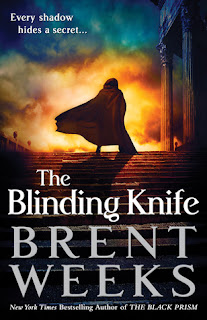
The Blinding Knife (Lightbringer #2), by Brent Weeks

book cover The Blinding Knife continues the story of Kip the bastard, Gavin/Dazen Guile the genius god-like Prism and just about every other person alive a mere mortal. It is just as entertaining as the first book, although more focused on action than lore. A lot of new concepts are explored here, like colors that are not on the spectrum but can be drafted, other gods, other chromatic skills, but, as fantasy focused on little boys taught us, always unexplained, mysterious, too young to understand, people dying before they can finish their sentence, etc. I hate that cliché and I really hope people would stop using it so much. I am talking to you, Brent Weeks!

Anyway, I can't say anything more about the story or the style or the author than I did when I read the first book in the Lightbringer series. It's a continuous story, split in book sized volumes. I will start reading the next book in the saga momentarily. I recommend the writing style and I like the attention to detail and the lore, although after a while the boy genius recipe feels more and more like a Japanese manga and less than a real story.

Thursday, 20 June 2019

Serializing FileInfo or DirectoryInfo with Newtonsoft Json in .NET Core

The Problem


Phew, that's a mouthful. But the issue is that trying to serialize a FileInfo or a DirectoryInfo object with Newtonsoft's Json library in .NET Core fails with a vague exception:
Newtonsoft.Json.JsonSerializationException: Unable to serialize instance of 'System.IO.DirectoryInfo'.
at Newtonsoft.Json.Serialization.DefaultContractResolver.ThrowUnableToSerializeError(Object o, StreamingContext context)
at Newtonsoft.Json.Serialization.JsonContract.InvokeOnSerializing(Object o, StreamingContext context)
at Newtonsoft.Json.Serialization.JsonSerializerInternalWriter.OnSerializing(JsonWriter writer, JsonContract contract, Object value)
at Newtonsoft.Json.Serialization.JsonSerializerInternalWriter.SerializeObject(JsonWriter writer, Object value, JsonObjectContract contract, JsonProperty member, JsonContainerContract collectionContract, JsonProperty containerProperty)
at Newtonsoft.Json.Serialization.JsonSerializerInternalWriter.Serialize(JsonWriter jsonWriter, Object value, Type objectType)

It doesn't say why it fails, just that a method called ThrowUnableToSerializeError threw um... an unable to serialize error?

The Cause


Looking at the Newtonsoft code, we eventually get to this piece of code:
// serializing DirectoryInfo without ISerializable will stackoverflow
// https://github.com/JamesNK/Newtonsoft.Json/issues/1541
if
(Array.IndexOf(BlacklistedTypeNames, objectType.FullName) != -1)
{
contract.OnSerializingCallbacks.Add(ThrowUnableToSerializeError);
}

Later, another piece of code will execute the serializing callbacks and throw the exception. We can get rid of this functionality, by using a custom contract resolver, like this:
var settings = new JsonSerializerSettings
{
ContractResolver = new FileInfoContractResolver()
};
 
private class FileInfoContractResolver : DefaultContractResolver
{
protected override JsonContract CreateContract(Type objectType)
{
var result = base.CreateContract(objectType);
if (typeof(FileSystemInfo).IsAssignableFrom(objectType))
{
result.OnSerializingCallbacks.Clear();
}
return result;
}
}

Yet now, when trying to serialize, we get the stack overflow exception described in the original Newtonsoft.Json issue. It stems from the difference between the .NET Framework implementation and the .NET Core implementation of ISerializable in FileSystemInfo, which in Core just throws PlatformNotSupportedException. It's still not clear why it goes to a StackOverflowException, probably some conflict with Newtonsoft code, but it's clear Microsoft does not intend to make these classes serializable. If you think about it, those classes suck for so many reasons!

The Solution


So, in order to solve it, we will use a custom JSON converter:
private class FileSystemInfoConverter:JsonConverter
{
public override bool CanConvert(Type objectType)
{
return typeof(FileSystemInfo).IsAssignableFrom(objectType);
}
 
public override object ReadJson(JsonReader reader, Type objectType, object existingValue, JsonSerializer serializer)
{
if (reader.TokenType == JsonToken.Null)
return null;
var jObject = JObject.Load(reader);
var fullPath = jObject["FullPath"].Value<string>();
return Activator.CreateInstance(objectType, fullPath);
}
 
public override void WriteJson(JsonWriter writer, object value, JsonSerializer serializer)
{
var info = value as FileSystemInfo;
var obj = info == null
? null
: new
{
FullPath = info.FullName
};
var token = JToken.FromObject(obj);
token.WriteTo(writer);
}
}
And we use it like this:
var settings = new JsonSerializerSettings
{
Converters = new List<JsonConverter>
{
new FileSystemInfoConverter()
}
};
var json = JsonConvert.SerializeObject(dir, settings);
var info = JsonConvert.DeserializeObject<DirectoryInfo>(json, settings);

Why FileInfo and DirectoryInfo suck


The answer of a senior developer to any question should be "Why?" or "Why on Earth or anywhere in the Solar System would you want to do a dumb thing like that?!?!". Why would you want to serialize a directory or file info object? The answer is that you should not. The info objects are defined by only one thing: a path, but they have so much baggage: properties that access the file system, unsafe methods, no interfaces or factory methods that can allow them to be mocked in unit tests. They might look like data objects, but they are not!

Imagine a scenario where you have a list of all the files in your drive. You enumerated them all and now you want to serialize them. Should the serializer save Exists or Length, for example? Because that means it will access the file system for each of them in the process of serialization, leading to a lot of work, propensity to access errors and so on.

Best practices say you should either use some model classes to move around data, like an empty FileSystemInfoModel with Type and FullPath and maybe Attributes or Size properties or whatever you want to save, but that you set yourself as a separate responsibility. And if you want to use the functionality of the Info classes, use System.IO.Abstractions or the new Core IFileProvider abstraction to get implementations of interfaces that you can mock in unit tests.

Tell me what you think.

Monday, 17 June 2019

The Crown Tower (The Riyria Chronicles #1), by Michael J. Sullivan

book cover It seems there is a dedicated fan base for the Riyria series that so enjoy the setup that they ignore the quality (or lack thereof) of the writing. The writing style is amateurish at best, the characters are not fleshed out, yet the little building they get is contradicted with impunity whenever the plot requires it, the point of the story of the book has not been revealed after more than half of it, while the plot doesn't make any sense most of the time.

I am sorry, Michael J. Sullivan, but I could only read 60% of The Crown Tower before deciding I will not continue and I will not try any of the other books in the series. For the readers, imagine a story about implausibly competent youngsters that are forced to work together by a kindly old professor for no good reason other than they have to work together. Imagine a prostitute who decides to fight the world and open her own brothel, right across the street from her former pimp and king of the street, but the only concerns she has is how to bribe city officials to give her a business permit. After half of the book in which the characters have barely begun to do any of the activities listed above, nothing really happened, while hints have been placed to imply this is a world where magic exists, goblins, elves, dwarves, gods, yet none of them made an appearance.

I don't understand how stuff like that gets any awards. Is it just because they sell? Toilet paper sells and doesn't win anything! Just... ugh!

Sunday, 16 June 2019

The Fear Factor: How One Emotion Connects Altruists, Psychopaths, and Everyone In-Between, by Abigail Marsh

book cover You remember when you had to write a paper for college and you had the thing that you wanted to say, but then your coordinator told you to make it a chapter, and then add others that are related for context? This book kind of feels like that. In English it is called The Fear Factor, but the Romanian edition calls it "Altruist or being good without reward" (my direct translation, as Good for Nothing didn't feel right, even if it is the title of the book in the UK), showing that even editors didn't really agree with the author on the right way to label it.

Overall, what Abigal Marsh tries to say is simple: our capacity to do good to others without expecting a reward stems from an ancient mammalian mechanism designed to bond mothers to children and it is triggered by our ability to empathize with the fear other feel, while regulated by a network of brain centers, mainly our amygdala and hippocampus using the oxytocin hormone. This takes the book through eight chapters, each kind of separate and which I liked in different measures. The ones describing carefully crafted experiments and their outcomes I liked best, the ones that felt like fillers or the ones affirming that correlation doesn't imply causation then proceeding in describing a lot of correlation less so.

Marsh goes out of her way to portray a positive image of humanity, where most people are generous, empathetic and altruistic. She describes people who aren't capable of it - psychopaths and their amygdala dysfunction, people on the other side of the curve - superaltruists who don't care to whom they do good, they just do it, goes to very interesting experiments and comes with theories about how and why altruism, fear and empathy work. Her conclusion is that our focus on negative things makes us falsely believe things are getting worse, people less trustworthy, when the actual opposite if overwhelmingly true.

Bottom line: I liked the book, but some of the chapters felt forced. I didn't really need the exposition of her beach trip to save the turtles or how much she feared and then appreciated the help of a random guy who looked like a hood thug. Most of the information interesting to me was concentrated in the first chapters, while the last, explaining what to do to become more altruistic and how that improves our well being and filled with international statistical charts on altruism I could have done without entirely. It's not that it wasn't correct or well written, it just felt like an add on that had little to do with the book or, worse, was there just to fill up space.

If you search on TED Talks, you will see the author have a talk there titled Abigail Marsh: Why some people are more altruistic than others.