Friday, 17 April 2015

A World Out of Time, by Larry Niven

Book cover A World Out of Time is a book out of time as well. Larry Niven wrote the book in 1976 and it describes events that happen over a span of three million years, but it feels like The Time Machine. The hero is a guy from the 70s who's memory gets uploaded in the body of a convict hundreds years later, sent on a mission that was supposed to last tens of thousand of years (Earth time), but ending up in a joyride around the galaxy that brings him back on Earth millions of years later. The strange world of immortal creatures living like feudal savages in a world filled with broken and discarded technological wonder, but somehow still looking human, is difficult to take in. The cowboyish behaviour of the lead character and his inconsistent switch between genius and ineptitude don't help either.

It doesn't mean the book is not entertaining. I had fun with it. However it feels really long and old and I don't intend to read the other two Niven books in the same batch: The Integral Trees and The Smoke Ring, even if they sound slightly more interesting.

Wednesday, 15 April 2015

Firefight (The Reckoners Series book 2), by Brandon Sanderson

book cover The second book of The Reckoners series revolves around Firefight, a character from Steelheart, the first book, that I cannot explain without spoiling it. Brandon Sanderson outdid himself, managing to describe a dark world of bright colors, a desperate and dramatic situation in which hope shines through, an impossible romance inside a war story and a totally positive view on fear. Contrasts everywhere, like a bad metaphor that discovers it is a simile before a book ends. Well, if you read Firefight you will get the reference.

The action and plot of the book are much more detailed and a level above what happened in Steelheart. The villain is more interesting, the interactions between the members of the team are more complex, with various shades of conflict, plus an interesting new location in a sunken city filled with glowing plants that feed the people and provide light at the same time. I can't wait for Calamity, the third book in the series, to appear in 2016.

Sunday, 12 April 2015

Steelheart, by Brandon Sanderson

Steelheart cover I am starting to like Brandon Sanderson. Only at the end of Steelheart did I realize that he kind of used the same plot device that he used for Elantris: the ten-years-ago one. Ten years before the action of the book, Calamity struck: a red star-like light in the sky that gave random people immense powers. The governments of the world tried to fight back, but all of them ended up capitulating, declaring "epics" as impossible to control as natural disasters. Enter David (the name probably not chosen at random) an eight year old child who witnesses the death of his father at the hands of an epic that then proceeds on taking over Chicago as his personal fiefdom. Now, at 18, David meets with The Reckoners - a group dedicated to fight back - in order to avenge his father.

First book in The Reckoners series, which is a planned trilogy, Steelheart is a very refreshing take on the superhero genre, original in the sense that it takes its name after the main villain and follows a young boy who advances in life using his cunning, knowledge and personal effort, not some random superpower. The characters are easy to sympathize with and the story is very nice. Not everything is perfect, as the story contains many political, economic and even technical plotholes. However, the writing is very well done, easily making the reader forget and forgive any inconsistencies between reality and the storyline.

As with Elantris, I listened to the audio version of the book. Classical narration, but was very nice. The book is a sort of young adult thing, but I enjoyed it very much nonetheless. I can't wait for the second book in the series: Firefight. I may have to first read Mitosis, a short story placed in the same universe.

Friday, 10 April 2015

Elantris, by Brandon Sanderson

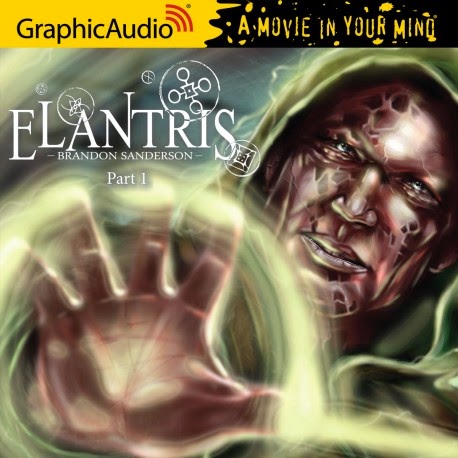
audio book cover for part 1 In a world dominated by trilogies and quadrilogies and sagas, it is refreshing to see that some people are writing stand-alone fantasy books. I've first heard of Brandon Sanderson when he ended up writing the last books in the Wheel of Time series, after its initial author died; those books were the best in the series, even if he had to work with Jordan's notes. Recently, I've stumbled upon this audio adaptation of Sanderson's book Elantris, produced by Graphic Audio, a company that doesn't just created narrations of books, but full audio plays - while changing nothing of the initial text.

Despite some parts being a bit too optimistic, some too slow and some really obvious - waiting for a character to catch up with you is not fun - the book was really entertaining and original. It also was Sanderson's first widely released book, so I can forgive his lack of perfection :). I really liked the story and the characters in the book. In truth, the book's message is one of hope, one of encouragement toward the human spirit becoming the best it can be. I couldn't help thinking that Sanderson probably portrayed himself in Raoden, and that guy is great.

Anyway, the plot revolves around the magical city of Elantris, populated by God like creatures that shine with the light of magic and are almost omnipotent. However, the story starts ten years after a horrible collapse of said city, which transformed every Elantrian into an immortal husk, heart not beating, hair falling, skin blotched by dark spots, incapable of healing the smallest cut or bruise, but fully capable of pain, unneeding of food, but fully able to feel ravenous hunger at all times. The process, called Shaod, has not ended, it still occasionally picks people at random and turns them into these creatures of eternal pain. The human inhabitants of nearby towns have quarantined Elantris and anyone affected by the Shaod is thrown inside the rotting city.

There are two main characters: prince Raoden and his bride to be, princess of a nearby kingdom, called Sarene. Not only them, but almost every actor is full of spirit (pun intended) and really likable, even the antagonists can be understood and sympathized with. The story is full of events that lead to character development, politics, smart plotting, drama and comedy.

Well, in the end, with all my talk of stand alone books, I was a bit sad to see the story end. I wanted more, and that's a good sign, right? Sanderson is supposedly considering writing a sequel, but it's not something that will happen soon and it will involve different characters. I liked Elantris and I recommend it to all fantasy fans.

Tuesday, 7 April 2015

Chronicles of Amber books 6 through 10, the Merlin Cycle, by Roger Zelazny

There would be no point for reviewing the individual books, since, like with Corwin, it is one big story spanning five books. Eight years after the first five disappointing books in the series were published, Roger Zelazny comes back with a little more writing skill, a more interesting plot and a different character. That's the good news. The bad news is that it is pretty much like the Corwin cycle, only with a guy that uses magic instead of a stupid sword. His name is Merlin and he is Corwin's and Dara's son, inheriting both Amber and Chaotic blood. Somehow he still gets his ass kicked by his father, though.

The characters are again, like something from a high school teen movie set in the middle ages. People are mortal enemies and then make conversation, make up and help each other against another mortal enemy, who will probably help them both sometimes later. Arrogant nobility behavior mixes with a general ineptitude to use any knowledge from the "shadow lands" even if a lot of the characters gain their education on Earth. The only interesting thing seems to be an AI that Merlin created... which then calls him dad and acts just like every other generic character in the books. And everybody is just so amazingly and mind stunningly stupid! I couldn't take another book in this crappy series.

Bottom line: The Amber Chronicles was a total waste of my time, the only advantage it has being that its writer ended both cycles and then died, making any sequels improbable. I kid you not, Eragon was way better and it was written by a 19 year old!

Tuesday, 31 March 2015

The Courts of Chaos, by Roger Zelazny (Amber series book V)

Book cover And thus ends the fifth book in the Chronicles of Amber, and the last in the Corwin cycle. Written between 1970 and 1978 by Roger Zelazny, it was one of the most lazy fantasy series I've read so far. The Courts of Chaos is once again a book that has no connection with its title. Nothing really happens in the courts of chaos except at the very end. All previous developments in the story are discarded completely and it feels like the author slept through writing the book. It was one of the most WTF books in the series so far, as well. At every section there was at least one scene where I felt like those people watching football games and shouting at their TV about what the player should have done.

Let me give you some examples. The book itself starts with a circular time paradox, where we get to see Corwin cut off Benedict's artificial arm. This had already happened in the previous book, but from the other perspective. Thus the metallic arm was only there to be severed because it has been severed in the past, its origins non existent. Then each of the children are given orders by their father. Why would they listen to them is beyond me, as was his entire reason for leaving, reappearing, etc. Anyway, he sends Corwin on a quest to carry the Jewel of Judgement (nobody did any judgement with that stone!!) to the courts of chaos, where Benedict already went using a trump card. Of course, why call Corwin's grandfather to make another card so that he can get there instantaneously? Why indeed. So we are exposed to this totally boring expedition where people fight like children with swords and crossbows and throwing rocks at each other. No guns, of course, that would be cheating. When Corwin uses a stone to make his enemy drop his crossbow, he ignores the crossbow and almost dies in the process. When he gets to the crossbow again, he smashes it! Why use a ranged weapon at all? Oberon made a blood raven out of a bit of Corwin's blood, to accompany and protect him in shadow. Why not make a bloody (pun intended) army of ravens? Wouldn't that have been better? And it just goes on and on. They never use the cards in this book, for example, after it was already obvious they can be used as communication devices as well as offensive weapons.

Nothing really made sense, in a nutshell. I am pretty convinced Zelazny was stoned out of his mind when he wrote this, but with some bad shit, since it never seems to increase his creativity. The ending was like a slap in the face, as after their victory, using armies of pedestrians and cavalry, a funeral procession for Oberon appears out of nowhere, with a lot of people and dragons. I kid you not, they had dragons, but their only use was decorative, like some sort of Chinatown celebration paper-mache things. And they got there not by treading the land like idiot Corwin, they actually came directly there. Oh, and since Corwin didn't feel like being king, they crowned another brother. Who, you might ask? Is it the brilliant strategist Benedict? Is it the loyal and strong Gerard? Is it the devious and aloof Julian? No, it's totally Random (another pun, couldn't help myself).

The next book in the series is the first in the Merlin cycle and the first book was written in 1986. It gives me hope that in 10 years Zelazny learned to fucking write!

Sunday, 29 March 2015